
QUAIL SPECIES & VARIETIES
Choose the Right Quail Breed for Your Farm
Compare egg production, meat yield, temperament, and care requirements across popular homestead quail breeds.
6+
Popular Breeds
300
Max Eggs/Year (Coturnix)
6 Weeks
Maturity to Lay
14 oz
Jumbo Meat Yield
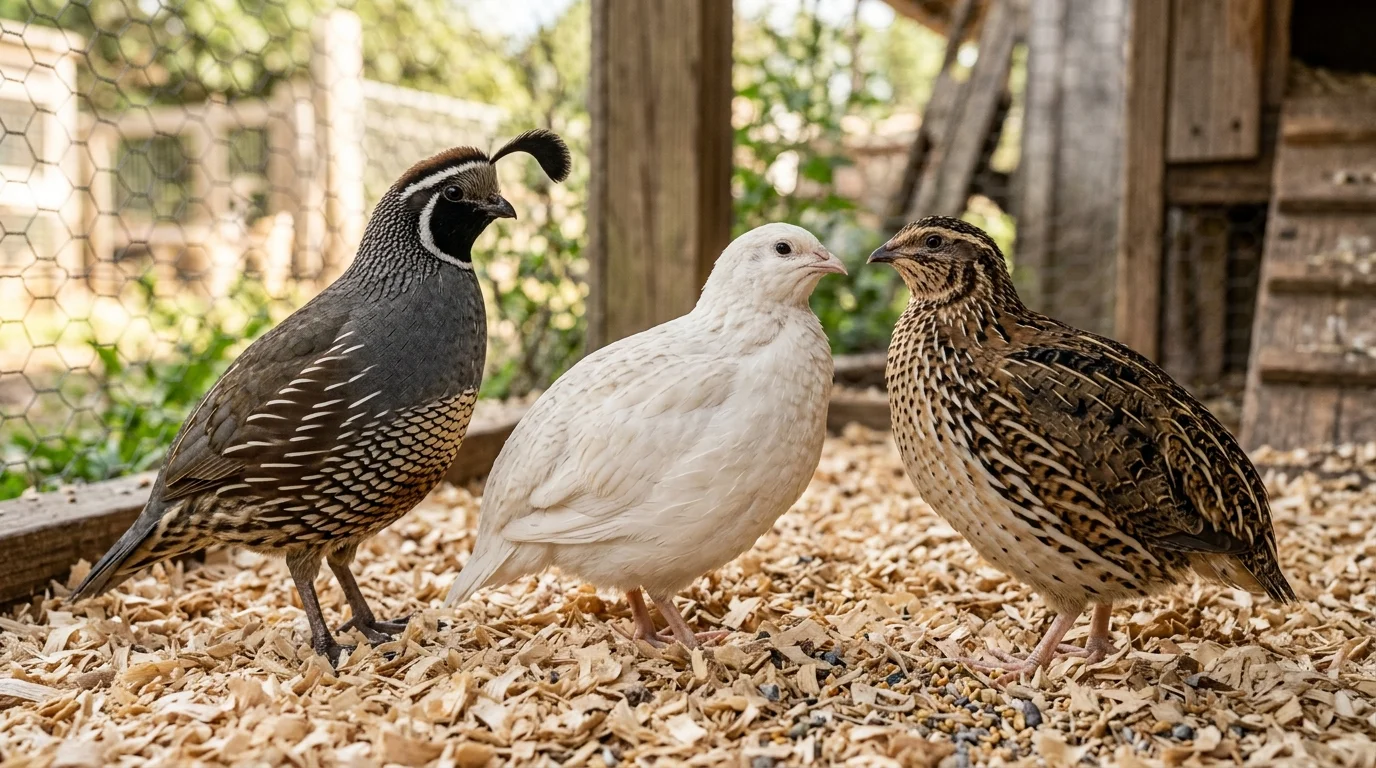
What Should You Know Before Choosing a Quail Breed?
The right quail breed is the one that matches your primary goal—eggs, meat, feathers, companionship, or hunting-dog training—because no single breed excels at all of them at once. There are roughly 130 quail species worldwide, but only a small handful are practical for farm or backyard settings, and the gap between a “beginner-friendly” bird and a “specialist-only” bird is wider than most new keepers expect.
Among the domesticated species, differences in temperament, growth rate, and productivity are dramatic enough to make or break a keeper’s experience. A calm, cage-tolerant bird bred for captivity over generations behaves nothing like a flighty wild species that panics at a shadow, and the housing, licensing, and daily management each one demands can vary just as much. This is why breed selection has to happen before you buy a coop, an incubator, or your first dozen chicks — retrofitting a setup built for the wrong bird almost always costs more than getting it right from the start.
This guide walks through the major farm-relevant breeds — Coturnix, Bobwhite, California, Gambel’s, Button, and Blue Scale Quail — along with the rarer wild species keepers ask about, a full species choice framework built around purpose, climate, and space, and a set of direct answers to the questions people search most often when comparing breeds. Real trade-offs are called out plainly throughout, because the “best” breed on paper is frequently not the best breed for a specific yard, budget, or noise-sensitive neighbourhood.
What Are the Different Breeds of Quail?
The different breeds of quail split primarily along purpose: some are bred for meat production, some for egg production, some for their calls or feather patterns, and some purely for enjoyment as an ornamental or companion bird. This purpose-driven selection approach is the fastest way to narrow a list of a dozen candidate breeds down to two or three worth researching in depth, because breeds that look similar on a hatchery page often diverge sharply once you compare their size variation, egg production variation, and temperament variation side by side.
Beyond purpose, breeds also differ in social structure and daily-care demands. Some species live comfortably in coveys suited to large-scale operations, while others require bonded pairs and a planted aviary setup to stay calm. Flight capability varies enormously too — a bird that clears six feet from a standing start needs a covered enclosure, while a heavier, ground-hugging breed does not. Because these are still game birds at heart, most also carry higher protein requirements than chickens, a detail that trips up keepers moving from standard backyard poultry feed programs.
For anyone building a genuine breed-selection framework, the practical comparison points are consistent across every breed profile in this guide: annual output, age at first lay, egg size, feed efficiency, ease of breeding, beginner-suitability, and incubation success rates. A productive flock and a profitable flock are not automatically the same thing, so end-goal framing — deciding up front whether you want food, income, feather quality for crafts and fly-tying, or simply a food source for your own table — should drive every decision from here on. It also helps to separate the species vs breed distinction: within the broader game bird classification, only a few true species have been developed into multiple captive-bred quail varieties, while most of what people call “breeds” outside Coturnix are really just distinct wild species adapted to captivity with varying success. Framed this way, Old World vs New World quail becomes a genuinely useful starting filter, since Old World birds (Coturnix) tend toward calm productivity, while New World birds (Bobwhite, California, Gambel’s) tend toward higher management demands — a distinction worth building into any quail keeping goals checklist before backyard flock planning begins in earnest.
What Makes the Coturnix (Japanese) Quail Worth Raising?
The right quail breed is the one that matches your primary goal—eggs, meat, feathers, companionship, or hunting-dog training—because no single breed excels at all of them at once. There are roughly 130 quail species worldwide, but only a small handful are practical for farm or backyard settings, and the gap between a “beginner-friendly” bird and a “specialist-only” bird is wider than most new keepers expect.
Among the domesticated species, differences in temperament, growth rate, and productivity are dramatic enough to make or break a keeper’s experience. A calm, cage-tolerant bird bred for captivity over generations behaves nothing like a flighty wild species that panics at a shadow, and the housing, licensing, and daily management each one demands can vary just as much. This is why breed selection has to happen before you buy a coop, an incubator, or your first dozen chicks — retrofitting a setup built for the wrong bird almost always costs more than getting it right from the start.
This guide walks through the major farm-relevant breeds — Coturnix, Bobwhite, California, Gambel’s, Button, and Blue Scale Quail — along with the rarer wild species keepers ask about, a full species choice framework built around purpose, climate, and space, and a set of direct answers to the questions people search most often when comparing breeds. Real trade-offs are called out plainly throughout, because the “best” breed on paper is frequently not the best breed for a specific yard, budget, or noise-sensitive neighbourhood.
Where Did the Coturnix Quail Come From and How Do You Identify One?
The Coturnix Quail, also called the Japanese Quail, originated as a migratory Old World species across East Asia and the Palearctic, and today’s domesticated lines are the product of over a century of selective breeding programs that traded migratory instinct for productivity. You can identify one by its compact body, mottled brown plumage in the wild-type color, and its distinctive crowing call in males — a short, buzzy trill quite different from a chicken’s crow.
As a beginner species, Coturnix stands out for its docile temperament and general easy to handle nature; most lines tolerate chick handling and regular contact well enough that many keepers describe mature hens as genuinely tame and even snuggly. Physically, adult females typically weigh 120–160 g (4.5–6 oz), while adult males run slightly smaller at 100–140 g (4–5 oz) — a size difference useful for sexing by feather pattern once birds reach 3–4 weeks of age, when females develop a whitish speckled breast and males show a rusty orange breast. Beyond visual cues, this breed’s fast maturity is its defining trait: most lines are table-ready at 6–7 weeks, reach breeding age at 9 weeks, hit sexual maturity at 7–9 weeks, and carry a life expectancy of 2–5 years in captivity, which is short compared to a backyard chicken but entirely normal for the species. The scientific name Coturnix japonica (or Coturnix coturnix japonica, depending on the taxonomy you follow) reflects a quail domestication timeline stretching back centuries in Japan and China, and the breed is still sometimes sold under its historic alternate names, Egyptian Quail and Italian Quail — labels tied more to specific color strains and old trade routes than to any real difference in species. New keepers should also plan brooder temperature for chicks carefully, since Coturnix chicks are smaller and chill faster than chicken chicks during their first two weeks.
What Color Varieties Does the Coturnix Quail Come In?
The Coturnix Quail comes in dozens of recognized color varieties, all of which are cosmetic mutations of the same underlying species rather than separate breeds with different production traits. The wild-type coloring, known as Pharaoh Quail, remains the most common color variety and the baseline against which every other mutation is compared, but breeding programs — including well-documented work out of Texas A&M — have stabilized dozens of additional color/mutation varieties over the past several decades.
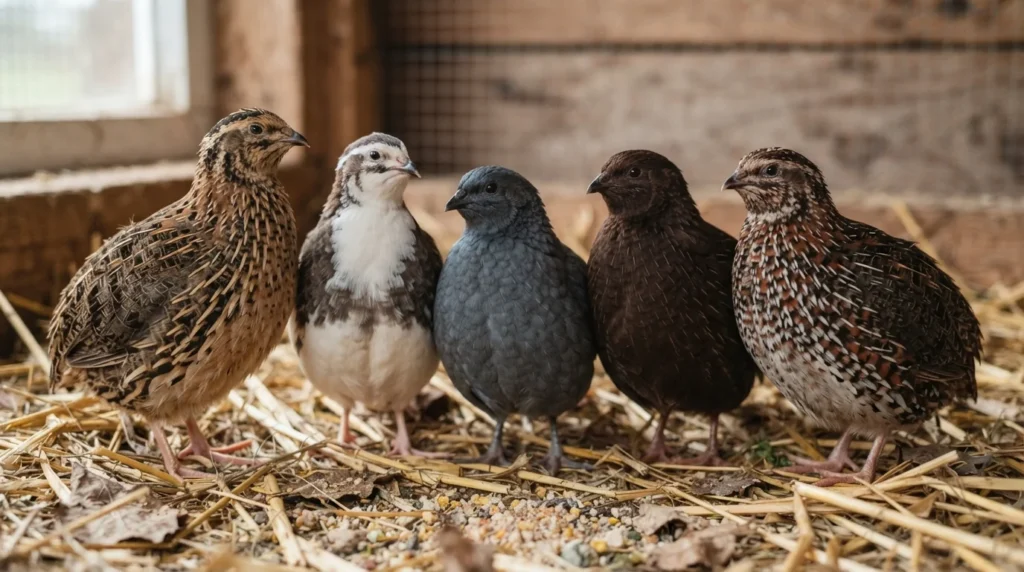
Among the most requested varieties, the celadon quail stands apart for a genetic trait rather than a plumage trait: birds carrying the celadon gene lay blue quail eggs instead of the typical speckled brown shell, and breeders frequently search specifically for celadon quail eggs or hatching stock described as celadon coturnix quail to establish this trait in their own flock. Comparing a celadon quail vs coturnix quail is technically comparing a genetic subtype to its parent species, since celadon is a coturnix quail color genetics trait layered onto standard Coturnix rather than a separate lineage — the same is true for a blue coturnix quail or a bird marketed as laying quail eggs blue, all of which describe the same underlying gene expressed slightly differently depending on the bird’s other color genes. Beyond the blue-egg lines, keepers building a varied flock also look for the Andalusian quail (a slate-blue plumage mutation), the pansy quail and pansy coturnix quail (a mottled, multi-toned pattern), the rosetta quail (a speckled, rosette-like feather marking), cinnamon coturnix quail (a warm reddish-brown mutation), and German Pastel quail (a soft, muted color line developed for exhibition). Other named varieties in common circulation include English White, Golden/Manchurian Coturnix, Tibetan — recognizable by its dark chocolate coloring from the extended brown gene — and Tuxedo, a white-bodied bird with dark head markings.
Crossbreeding between these lines is common and often intentional: pairing two Tuxedo birds, for instance, produces a predictable split of roughly 50% Rosetta, 25% Tibetan, 25% Pharaoh-colored offspring, which is one reason flocks kept purely for their look tend to show significant flock plumage variation within a few generations. This has turned color-variety crossing into something of a hobby in its own right, similar in spirit to color genetics work in rabbits or budgerigars, and keepers serious about it often keep a color genetics chart on hand to track which pairings produce which show-quality plumage outcomes. Less common but still documented varieties include Silver Coturnix, Fawn Coturnix, a true Pharaoh Coturnix quail line kept close to the original wild coloring, and birds showing British Range/Roux coloring, along with practical curiosities like the calico quail pattern and Tibetan quail chick down coloring, which differs noticeably from adult plumage and can make early color-sexing tricky for new breeders. Buyers comparing the different colors of Coturnix quail available from a given hatchery will often see a Rosetta Coturnix quail line listed right alongside Pharaoh and Tibetan stock, since all three are commonly bred together for variety. It’s worth noting plainly that color has no meaningful effect on egg production, growth rate, or temperament — the decision to keep a specific coturnix quail egg colors line or plumage pattern is almost always aesthetic or market-driven rather than practical.
What Are Jumbo and Giant Coturnix Quail Breeds?
Jumbo and giant Coturnix quail breeds are selectively bred meat strains of the standard Coturnix Quail, developed specifically to grow larger and yield more usable meat per bird without sacrificing the species’ fast maturity. A Jumbo Coturnix Quail can reach up to 16 oz live weight, roughly double a standard-line bird, which is why keepers searching for biggest quail, large quail, big quail breeds, the largest breed of quail, or simply the biggest quail breed overall are almost always led back to this strain rather than a different species entirely.
This size difference comes from decades of selectively bred body weight targeting, not from crossbreeding with a larger species — a jumbo coturnix quail is genetically still Coturnix japonica, just pushed toward a heavier phenotype the same way broiler chickens were developed from standard layer stock. In practical terms, that means birds marketed as jumbo quail, coturnix jumbo quail, or giant quail still mature on a similar timeline to standard Coturnix, just finishing at a noticeably heavier jumbo coturnix quail size; keepers tracking jumbo coturnix quail chicks through their first weeks typically see a visible weight gap open up by three to four weeks of age. Egg production holds up well in these lines too — most jumbo quails still produce 220–280 eggs per year, and because the hens themselves are larger, they also lay larger eggs than standard Coturnix, which is exactly why jumbo Coturnix quail eggs and general jumbo quail size questions dominate buyer searches, alongside related terms like biggest quail eggs and largest quail eggs.
For anyone comparing quail large options, including birds sold as jumbo white coturnix quail, jumbo egyptian quail, jumbo italian quail, or jumbo wild coturnix quail, the practical differences usually come down to plumage color and breeder lineage rather than any real difference in size — the “jumbo” designation is what drives the weight, not the color variety layered on top of it. The main trade-off is better meat yield at a modest cost in feed efficiency, since larger bodies require proportionally more feed per bird even though the feed conversion ratio for jumbo lines remains competitive with other meat poultry.
For a farm planning broiler-style quail production, jumbo lines are usually the correct default: they deliver a better meat-to-bone ratio and heavier dressed carcass weight than standard Coturnix without the much slower growth curve of a true game bird like Bobwhite. If meat volume is the primary goal, jumbo breeding stock selection should prioritize documented growth-rate benchmarking from the hatchery over color or novelty, since jumbo lines vary meaningfully in quality between breeders despite being marketed under the same name.
What Housing, Breeding and Space Do Coturnix Quail Need?
Coturnix Quail need surprisingly little space compared to other poultry — as little as 1 square foot per bird in a colony setting, or 2 square feet per bird for more comfortable, aggression-free housing — which is a major part of why the breed dominates backyard and small-farm setups. In the U.S., keeping them requires no license, unlike every New World species covered later in this guide, which alone makes Coturnix the practical entry point for most new keepers.
Breeding-wise, the standard ratio is one male to 5–7 hens; overloading a pen with too many males drives over-mating and visible feather damage on hens, while too few males relative to hens can reduce the fertility rate of collected eggs. Keepers focused purely on eggs often skip males altogether and run egg-only keepers or hens-only groups, which eliminates crowing noise and territorial aggression entirely — a meaningful consideration for anyone in a suburban setting. Within a mixed pen, aggression reduction comes largely down to density and sex ratio rather than anything breed-specific, and most keepers find the birds settle into a stable pecking order within a few days of any change.
On the meat side, a distinct meat-focused variety exists that is more heavily muscled than standard laying lines, typically dressing out at 10–13 oz with white meat, pure white feathers, and a build clearly optimized as a genetic contributor to jumbo breeding programs — this is separate from the jumbo strain covered above, though the two are frequently crossed. Compared to this specialized meat bird, the standard size Coturnix reaches full growth at six weeks, hatches after an incubation period of 17–18 days, and produces birds that are good flyers by 8–10 weeks — worth noting for anyone housing them in an open-top pen, since even a supposedly docile breed can clear low fencing once fully feathered.
Overall, the breed’s easy-going temperament, hardy temperament, and generally quiet, calm, low-interaction nature make it genuinely easy to raise for people with no prior poultry experience; it also sees use as a training bird or hunting bird for young pointing dogs precisely because it flushes predictably and doesn’t require a hunting license the way Bobwhite does. Meat-focused lines are prized for being meaty while remaining prolific layers, and their light meat and light skin make for easy dressing, with well-fed birds reaching around 12 oz within eight weeks under good conditions. A well-designed setup should also account for brooder setup needs during the first two weeks, reliable quail coop ventilation, predator-proof wire mesh on every side including the floor, and a decision between colony cage vs cage-free housing depending on available grow-out pen sizing — birds also go through a molting cycle roughly once a year that temporarily slows laying regardless of housing style.
How Productive Are Coturnix Quail for Eggs, Lighting Needs and Feather Use?
Coturnix Quail are the most productive quail breed for eggs by a wide margin, with well-managed hens producing 250–300 eggs per year — a figure that puts them ahead of most backyard chicken breeds on a per-bird basis. This early laying onset combined with consistently high quality eggs is exactly why the breed sees such high demand eggs in both backyard and small commercial settings, and why it’s routinely cited as the top egg-laying choice among quail species.
Hens typically begin laying between 6–8 weeks of age and, given proper nutrition and supplemental lighting — specifically 14–16 hours of daily light — settle into steady laying at roughly 5–7 eggs per week during peak production, which for most hens amounts to near-daily laying. Eggs run medium in size relative to the bird’s body weight, and the breed’s eggs are widely considered the easiest to hatch of any quail species, which pairs naturally with the fact that Coturnix chicks are also the easiest to raise to maturity. This combination of traits is precisely what makes Coturnix a genuine dual-purpose breed: its commercial egg production lineage supports both a steady table-egg supply and a fast-growing meat bird from the same core stock, which is not something most other quail species can offer.
Beyond eggs, Coturnix carries real commercial weight — commercial operations worldwide rely on the breed’s excellent feed efficiency and high fertility rates to run profitable 250–300 eggs/year flocks at scale, and even hobby-level keepers can expect comparable results with basic care. The breed’s feathers also have secondary value: feather quality for crafts work, fly-tying use, and even fashion use are all realistic side markets, and while a Button/King Quail comparison shows the smaller species has finer decorative feathers, Coturnix feathers are collected more easily thanks to the bird’s minimal space requirement and generally cleaner feather collection from wire-mesh housing. Practically speaking, Coturnix also tolerates cooler conditions better than most tropical-origin quail — the breed is reasonably cold-hardy with appropriate shelter — and its low feed/water consumption relative to body size keeps ongoing costs modest. Most productive setups rely on wire-mesh flooring for a self-cleaning cage effect that simplifies droppings management, though this should be paired with a broader egg-laying cycle routine that includes candling fertile eggs, maintaining incubator humidity near 99.5°F, providing attentive hatch-day care, using a properly balanced layer feed formulation, and applying photoperiod manipulation carefully — sudden lighting changes can stress a flock even when the total daily hours are correct.
Is the Bobwhite Quail the Right Breed for Your Farm?
The Bobwhite Quail is the right breed for farms prioritizing meat flavor, hunting-dog training, or a genuinely wild-type game bird experience over raw egg or meat volume — it is the most popular native North American quail species, but it is also considerably harder to raise than Coturnix. Its slower maturity, stronger flight instinct, and licensing requirements mean it suits an experienced keeper, or a beginner who is prepared for a steeper learning curve than most hatchery marketing suggests.
Unlike Coturnix, Bobwhite is a true New World Quail, and that wild lineage shows up in almost every aspect of its care: it startles more easily, takes longer to reach laying age, and requires meaningfully more space per bird. None of that makes it a poor choice — for hunting preserves, dog-training operations, and keepers who specifically want the superior table flavor this breed is known for, Bobwhite remains the standard — but it does mean the decision to keep Bobwhite should be made with open eyes about the added management involved, which the sections below lay out in detail.
What Do Bobwhite Quail Eat and What Are Their Feathers Like?
Bobwhite Quail eat a diet closer to their wild ancestors than most domesticated poultry, thriving on a high-protein game bird starter feed supplemented with natural forage once they’re feathered out. As a true game bird and a popular hunting bird, Bobwhite retains strong foraging instincts even in captivity, and keepers who provide access to a run typically see birds actively hunting for bobwhite quail food on their own.
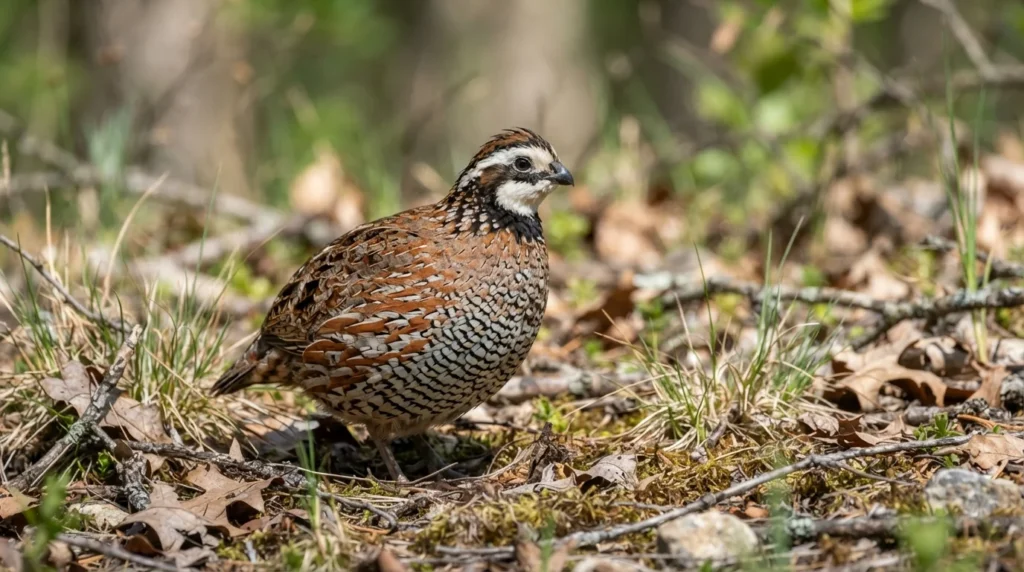
In the wild, this shows up as an insect-based diet during the growing season and foraging for seeds and greens the rest of the year, with grit for digestion playing an important role since Bobwhite, like most gallinaceous birds, lacks teeth and relies on grit in the gizzard to break down hard seed coats. Captive keepers should be aware of real wild vs captive diet differences — a commercial game bird ration covers protein needs reliably, but birds given some access to natural forage tend to show better feather condition and overall vigor. On the subject of bobwhite quail feathers, the species carries a mottled brown, tan, and white pattern that provides excellent camouflage in native grassland habitat, with males showing a distinctive white throat stripe bordered in black that females lack.
Bobwhite Quail vs. Coturnix Quail: What Are the Key Differences?
The key difference between Bobwhite and Coturnix Quail is speed versus flavor: Coturnix matures and produces far faster, while Bobwhite offers superior meat quality and a true wild-game character at the cost of a much longer production timeline. On raw coturnix quail vs bobwhite size, standard Bobwhite averages around 170 g (6 oz), though jumbo lines like the Butler strain can reach up to 16 oz, with jumbo males averaging closer to 12 oz — and the Georgia Giant variety runs roughly 3x the size of Northern Bobwhite, making direct breed-to-breed weight comparisons within Bobwhite itself almost as important as the comparison to Coturnix.
Maturity is where the two species diverge most sharply. Bobwhite shows slower maturity across the board, reaching table-ready weight around 14–16 weeks compared to Coturnix’s 6–7 weeks, and this longer growing period is widely credited with producing the breed’s superior meat flavor — a genuinely more approachable, farm-raised version of a New World species that remains, despite the added care, the most popular quail breed kept specifically for bird-dog training thanks to its strong flush response. That said, Bobwhite is meaningfully more difficult to raise than Coturnix: birds need roughly 16 weeks to flight capability and don’t reach laying age until 26 weeks, and even then function as only a moderate egg producer, typically delivering 100–200 eggs per year with first lay at 20–24 weeks. Combined with a naturally flighty temperament, this makes Bobwhite a poor match for keepers who want fast returns or minimal daily interaction.
On the positive side, the breed shows solid cold resilience for outdoor housing in temperate climates, and functions well as a genuine dual meat-and-egg option for keepers willing to accept the slower timeline — a temperament comparison chart run against Coturnix would show Bobwhite scoring notably higher on wariness, a growth-rate comparison would show it roughly two to two-and-a-half times slower to finish, and an egg-yield comparison would put it at roughly half of Coturnix’s annual output. A space-requirement comparison and noise-level comparison both favor Bobwhite slightly less than Coturnix as well, since the species needs more room per bird and males call loudly and frequently during breeding season — all of which factors into most beginner suitability comparison charts ranking Coturnix above Bobwhite for a first-time keeper.
How Do You Sex, Pair and Manage Bobwhite Quail Behavior?
Sexing Bobwhite Quail is done visually from around 12 weeks of age using facial markings: males show black facial masking, while females show a plainer buff-brown face — a distinction that holds for most subspecies but becomes genuinely difficult in the Tennessee Red line, where Tennessee Reds sexing difficulty is a well-known frustration even for experienced breeders. The Snowflake Bobwhite variety offers an easier alternative marker, with females showing a distinctive grey facial marking instead of the standard buff-brown.
As a true New World Quail native across the continental U.S., with roughly 20 subspecies recognized and populations extending into parts of the Caribbean range and Mexico range, Bobwhite is named for its call — the familiar bob-WHITE call that gives the species its common name and made it a well-documented part of Native American food use long before European colonization. Wild populations have seen serious wild population decline in recent decades, driven largely by habitat loss, and at least one extinct subspecies has already been lost — context worth knowing given how differently the captive-bred Northern Bobwhite, Butler Bobwhite, Snowflake Bobwhite, Georgia Giant, and Tennessee Red Bobwhite lines have adapted to farm life. All are non-migratory in captivity, but temperament varies by strain: the standard lines run aggressive or skittish, reflecting only ~25 years in captivity as a species compared to Coturnix’s centuries of domestication, and the Snowflake is generally considered the least aggressive strain while Tennessee Reds tend to be the most aggressive.
That wild-adjacent temperament has real management consequences. Birds under stress will flush and panic against cage walls or ceilings, creating genuine self-injury risk, which is why chick-stage handling matters so much for taming a flock early rather than trying to calm adults later. Breeding pairs should be observed directly for mating behavior observation rather than assumed from sexing alone, since Bobwhite reaches sexual maturity at 6 months and lays primarily during the spring laying season, roughly April–September, with off-season laying risk — pushing hens to lay outside this window through artificial lighting — linked to a shortened lifespan and unnecessary physical stress on the bird. The species also has a genuine bonded pairs requirement: established pairs show real pair-bond aggression toward intruders, and introducing a new bird into a mixed breeding group carries meaningful mixed breeding group risk. In the wild, Bobwhite display winter covey behavior, forming a re-pairing each spring pattern where they largely mate for life within a season, with female mate selection driving which pairs form — a dynamic best supported in captivity through first-year group housing followed by deliberate pairing once birds mature, rather than forcing pairs together prematurely.
What Housing, Licensing and Egg Production Should You Expect from Bobwhite Quail?
Bobwhite Quail housing starts at 4 square feet per adult bird, roughly four times the Coturnix minimum, with slightly less room — around 2 sq ft for young birds — acceptable before they reach full size. Overcrowding is a genuine welfare issue with this species: overcrowding aggression is common enough that many keepers default to same-sex groups or a females-only flock outside of active breeding season, both of which sidestep the pair-bond conflicts covered above.
Because of the species’ skittish nature, minimal handling is the general rule, reserved mainly for medical necessity handling, since routine handling raises real panic-induced injury risk in a bird prone to flushing. Given appropriate care, Bobwhite carries an average lifespan of 2–5 years, though up to 7 years documented in well-managed captive settings. Critically, in the United States, keeping Bobwhite legally requires a Fish and Wildlife Service license in most states — a meaningful difference from Coturnix that trips up plenty of first-time buyers who assume all quail are regulated the same way. Across the roughly 22 subspecies, there’s a notable asymmetry in appearance: female subspecies similarity is high, meaning hens look broadly alike across lines, while male subspecies variation is much more pronounced, making males the easier sex to identify a specific strain from.
For breeding, plan on two to three males per ten females — multiple mates per season is normal behavior for this species — while being cautious about new male introduction risk, since established pairs and hierarchies don’t absorb newcomers gracefully. Under good lighting and nutrition, Bobwhite can approach year-round laying potential, though this pushes against the bird’s natural seasonal rhythm and should be balanced against the stress concerns noted earlier. On the meat side, the Georgia Giant variety stands out, reaching nearly a pound at maturity and representing the upper end of Bobwhite size, while a well-managed hen can produce 100+ white eggs annually under ideal conditions — enough for genuine game-bird-production use or blended mixed-purpose operations that combine dog-training stock, meat birds, and egg production from a single flock.
Should You Raise California Quail on Your Property?
California Quail suits a property owner who wants an attractive, active bird for aviary display or light backyard interest rather than serious egg or meat production, since the species is a genuinely poor producer on both fronts. It thrives around human activity in ways most game birds don’t, which is part of its appeal, but its low output means it should be chosen for enjoyment rather than any practical farm output.
This is a species most often kept alongside other ornamental birds rather than as a standalone flock, and its housing and legal requirements track closely with the other New World species covered in this guide. The two sections below cover its natural diet and foraging behavior, followed by what actually raising a flock of these birds day to day involves.
What Does a California Quail Eat and How Does It Forage?
A California Quail eats a varied diet of seeds, greens, and insects gathered almost entirely through ground-foraging, which is exactly how the species has adapted so well to life near people. Its remarkable human proximity tolerance means wild coveys are a common sight in city parks, suburban gardens, and agricultural areas across its native range — a level of comfort around human activity that few other quail species share.
In terms of California quail food specifically, the California quail diet leans heavily on seed and insect forage supplemented by native plant browse, with grit consumption supporting digestion the same way it does in other ground-feeding game birds. Diet shifts seasonally, following whatever food source is most abundant, and captive birds do well when a seasonal diet shift is mimicked through a rotating mixed-flock feeding station rather than a single static feed formula year-round.
What Does Raising California Valley Quail Actually Involve?
Raising California Valley Quail involves accepting a genuinely low-yield, ornamental bird rather than a production breed — most hens lay only 50–120 eggs/year with variable age at first lay, figures that put the species firmly in ornamental keeping territory rather than anything resembling a working flock. The species is frequently described as beautiful but unproductive, and most keepers approach it from a conservation-minded keeping or beauty/game-bird interest angle rather than expecting meat or eggs.
Physically and behaviorally, California Quail shares a strong resemblance to Gambel’s Quail similarity in build and head plume, distinguished mainly by largely non-overlapping ranges in the wild; both display a curved head plume made of six overlapping feathers. The species also shows unusual cooperative parenting behavior, including brood mixing between different family groups — a trait linked to the longevity from cooperative care observed in wild coveys. This social nature makes California Quail a genuinely good aviary companion species, often housed successfully alongside finches, softbills, and small parrots in a mixed collection. As with Bobwhite, keeping this species in the U.S. legally requires a Fish and Wildlife Service license, and general New World Quail housing guidance — comparable space per bird and a broadly similar life expectancy to Gambel’s — applies here as well. Its status as the California state bird adds a layer of regional interest for keepers in-state, and successful setups typically combine thoughtful backyard covey management with careful mixed-species aviary planning and solid predator-proofing suburban runs, since a bird this poorly equipped to defend itself needs housing that does the defending for it.
Is the Gambel's Quail a Good Fit for Your Farm?
Gambel’s Quail is a good fit for experienced keepers drawn to a striking desert species for aviary display, but it is not recommended for beginners due to its high-strung temperament and specific housing needs. Anyone considering this breed should go in expecting a bird managed primarily for appearance and interest rather than production.
Like California Quail, Gambel’s rewards patience and careful housing far more than it rewards a hands-off approach, and its desert origins mean climate and enclosure design matter more here than with most other species in this guide. The next two sections cover where to responsibly source birds and what day-to-day temperament, sexing, and housing actually look like.
Where Can You Find Gambel's Quail for Sale?
Gambel’s Quail is available through specialty game bird hatcheries and private breeders rather than general poultry suppliers, and anyone searching gambel’s quail for sale should expect a more limited pool of sellers than for Coturnix or even Bobwhite. This reflects the breed’s status as not recommended for beginners — most reputable sellers cater specifically to experienced keepers who already understand aviary-style housing for a high-strung desert species.
Because sourcing options are limited, reputable quail breeder sourcing matters more here than with common breeds — checking for documented parent stock and clean health records is worth the extra effort. Buyers should also weigh hatching eggs vs day-old chicks based on their own incubation experience, prepare a proper desert-aviary setup checklist before birds arrive, account for real shipping stress considerations if ordering from out of state, and always plan to quarantine new stock separately from an existing flock for at least a couple of weeks.
The practical fix is aviary-style housing built around low cages that reduce the distance a startled bird can travel upward before hitting a ceiling, since handling-induced stress is otherwise a constant risk with this species. Sexing follows the same window as Bobwhite — around 12 weeks — using a black lower-face mask with white stripes and a rust-colored head on males, against a plainer buff-brown face on females. Gambel’s carries a life expectancy of 2–5 years, reaches sexual maturity at 6 months, and breeds during spring laying, generally forming pairs that mate for life in a pairs-only housing arrangement outside of natural seasonal-covey mixing that occurs in the wild. Breeders typically manage this with a re-pairing pattern each season, allowing 4 square feet per adult bird, and delaying any grouping before one year of age; maintaining opposite-sex visual separation between unrelated birds outside of active pairing also helps prevent unwanted aggression.
It’s worth stating plainly that Gambel’s is not a meat bird — this is strictly a fancy/aviary species kept for looks and interest, and as with the other New World quail in this guide, a Fish and Wildlife Service license is required to keep it legally in the U.S. Despite the housing demands, the species shows genuine aviary living suitability once properly set up, though mated pair aggression and general ground-dwelling bird conflict with other species sharing the same enclosure floor remain real considerations. Visually, Gambel’s appears in gray plumage, chestnut plumage, and cream plumage tones, with males topped by a bright red crest that makes the species one of the more photogenic quail available to hobbyists. One unusual behavioral note: chicks perform pre-hatch chick calling inside the egg, which triggers synchronized hatching across a clutch — a coordination mechanism thought to help chicks emerge together and reduce individual vulnerability.
What Is Gambel's Quail Temperament, Sexing and Housing Like?
Gambel’s Quail temperament runs high-strung and easily startled, which shapes nearly every housing decision for this non-migratory desert species native to Arizona, New Mexico, Colorado, Texas, Utah, and parts of northern Mexico. Its forward head plume and scaly underside plumage make it visually distinctive, but that same nervous energy means the bird is easily flushed, creating a genuine cage-ceiling head-striking risk in housing that isn’t designed with enough vertical clearance.
The practical fix is aviary-style housing built around low cages that reduce the distance a startled bird can travel upward before hitting a ceiling, since handling-induced stress is otherwise a constant risk with this species.
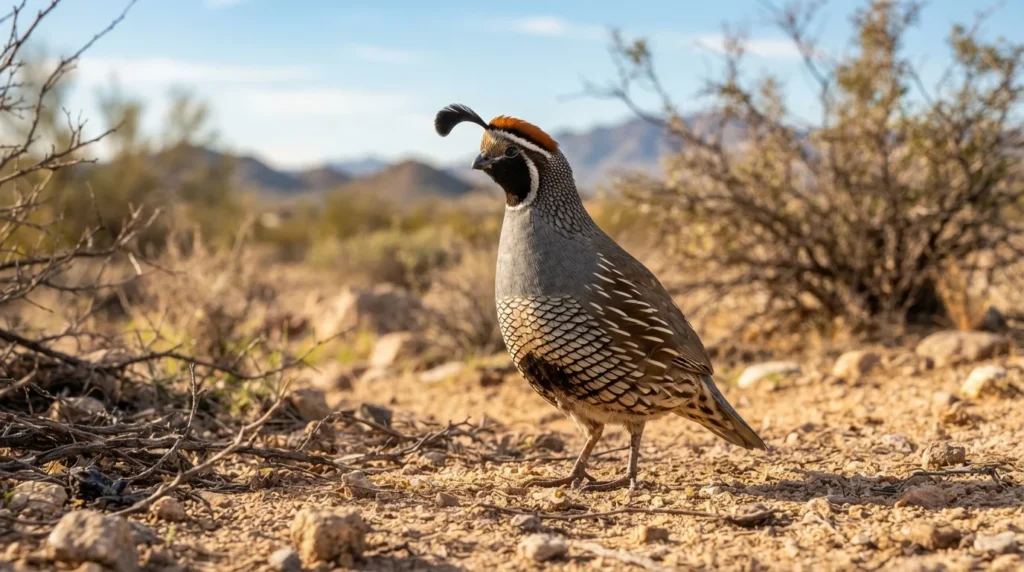
Sexing follows the same window as Bobwhite — around 12 weeks — using a black lower-face mask with white stripes and a rust-colored head on males, against a plainer buff-brown face on females. Gambel’s carries a life expectancy of 2–5 years, reaches sexual maturity at 6 months, and breeds during spring laying, generally forming pairs that mate for life in a pairs-only housing arrangement outside of natural seasonal-covey mixing that occurs in the wild. Breeders typically manage this with a re-pairing pattern each season, allowing 4 square feet per adult bird, and delaying any grouping before one year of age; maintaining opposite-sex visual separation between unrelated birds outside of active pairing also helps prevent unwanted aggression.
It’s worth stating plainly that Gambel’s is not a meat bird — this is strictly a fancy/aviary species kept for looks and interest, and as with the other New World quail in this guide, a Fish and Wildlife Service license is required to keep it legally in the U.S. Despite the housing demands, the species shows genuine aviary living suitability once properly set up, though mated pair aggression and general ground-dwelling bird conflict with other species sharing the same enclosure floor remain real considerations. Visually, Gambel’s appears in gray plumage, chestnut plumage, and cream plumage tones, with males topped by a bright red crest that makes the species one of the more photogenic quail available to hobbyists. One unusual behavioral note: chicks perform pre-hatch chick calling inside the egg, which triggers synchronized hatching across a clutch — a coordination mechanism thought to help chicks emerge together and reduce individual vulnerability.
Is the Button Quail Right for a Small-Space Setup?
The Button Quail is right for a small-space setup precisely because it is one of the smallest domesticated quail available, thriving indoors in a cage, aquarium, or planted vivarium where a larger breed simply wouldn’t fit. It is not a production bird by any measure — this is a quiet, visually interesting pet species best suited to apartment living or anyone wanting a low-maintenance, low-mess indoor bird rather than a source of eggs or meat.
Also sold as the King Quail or Chinese Painted Quail, this species occupies a completely different niche from every other breed in this guide. The four sections below cover its distinctive tiny eggs, feeding needs, size and lifespan, and the specific care approach — including strict pairing and a hands-off philosophy — that keeps this species healthy long term.
How Big Are Button Quail Eggs?
Button Quail eggs are tiny — roughly a quarter the size of a standard chicken egg — reflecting the extremely small size of the bird itself. The button quail egg size is genuinely one of the smallest of any commercially kept poultry species, and this tiny egg size (~1/4 the size of a chicken egg) is often the first surprise for new keepers who expect something closer to a Coturnix egg.
Because laying places real physiological demand on such a small bird, button quail eggs production is closely tied to calcium depletion, and prolonged heavy laying without adequate supplementation is a documented source of real egg-laying-related stress in hens. Each button quail egg takes roughly 16–18 days to incubate, a favorable egg-to-body-weight ratio given the bird’s tiny frame, and the eggs themselves carry a nutrient-dense egg profile relative to their size — though in practice, most keepers raise this species for its appearance rather than for any meaningful egg harvest.
What Do Button Quail Eat?
Button Quail eat a diet built around small, easily digestible particles rather than standard poultry feed, since their tiny beaks and bodies can’t manage the pellet sizes larger quail handle easily. A finely ground starter crumble forms the base of most feeding programs, with live insect supplementation — small crickets or mealworms — providing extra protein that this active, foraging species clearly benefits from.
Beyond the base ration, a seed mix for small birds rounds out the diet nicely, and fresh greens in moderation — finely chopped, to match the bird’s scale — add variety without overwhelming a digestive system this small. As with the closely related Coturnix, protein needs run higher than a typical songbird, so keepers should resist the temptation to feed a generic finch mix as the sole diet.
How Big Do Button Quail Get and How Long Do They Live?
Button Quail reach only about 1.4 oz at full maturity, making them one of the smallest domesticated quail species kept anywhere — anyone asking about the size of Button Quail is really asking about a compact small bird size that shapes every aspect of their housing. Despite this tiny frame, they’re reasonably long-lived for a bird their size, with a typical 3–5 year lifespan — though hens tend toward a somewhat shorter hen lifespan than males, largely attributable to the physical toll of frequent egg-laying discussed above.
This combination of small size and moderate lifespan makes Button Quail genuinely practical for compact housing footprint setups where floor space is at a premium, whether that’s a spare aquarium, a small cage, or a corner of a planted vivarium. Keepers should still plan around the bird’s hen egg-laying stamina, since even a small species can wear itself down without proper calcium and rest between laying cycles.
How Do You Care for Button Quail?
Caring for Button Quail means treating them as a quiet, viewing-only indoor pet rather than a handled or productive bird — this is the single most important mindset shift for anyone new to the species. Known interchangeably as Button Quail, King Quail, or Chinese Painted Quail, the breed originates in China, where it has long carried good fortune symbolism, and its button-sized chicks are genuinely one of the most charming sights in small-scale aviculture.
Taxonomically, Button Quail actually belongs to the Turnicidae family (unrelated) to true quail, which sit within the Phasianidae family — a distinction that matters for understanding why this species looks and behaves somewhat differently from Coturnix or Bobwhite despite the shared common name. It comes in numerous recognized color/mutation varieties, including Normal Wild, White, Red Breasted, Blue Faced, Cinnamon, Tuxedo Pied, and Splash Pied,
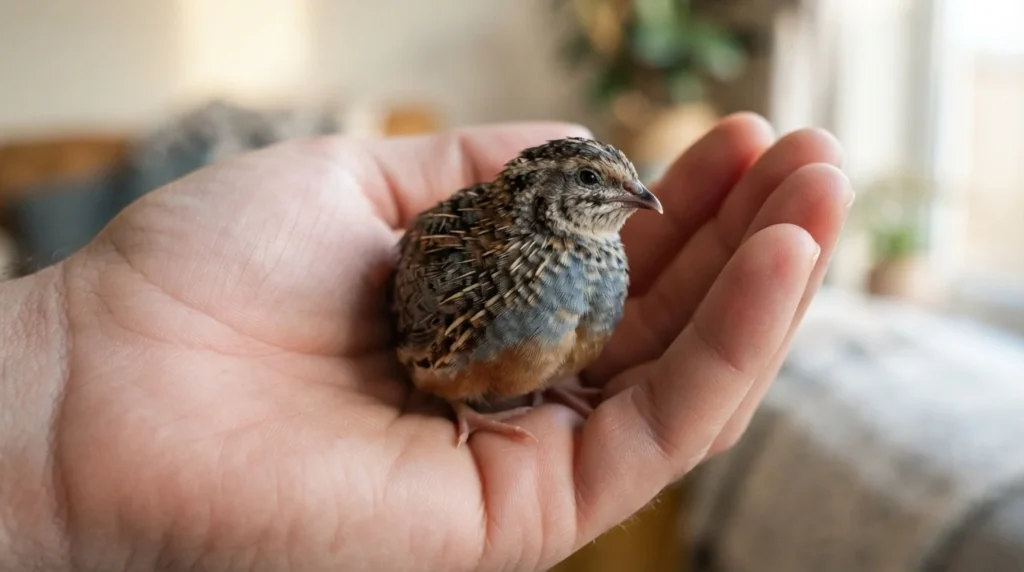
giving hobbyists plenty of room to specialize by color even within such a small species. Given its warm-climate origin, Button Quail does best with indoor-only keeping in most of the U.S., housed comfortably in cages, aquariums, or indoor aviaries as a genuinely quiet indoor pet. It’s broadly easy to keep and easy to breed once a few rules are respected: strict pair housing is essential, since this species does not tolerate group living the way Coturnix does, and sexing difficulty is real enough that most keepers rely on physical markers — a white throat line/bib marker and a vent-area feathering indicator — rather than guessing from behavior alone.
Birds reach sexual maturity at 8–12 weeks and do well in 4 square feet per pair, with the understanding that this is fundamentally a no handling/snuggling species kept for viewing-only pet enjoyment. Reassuringly, no U.S. license is required to keep them, and their fine plumage carries some feather quality for crafts and decorative use value on top of their appeal as a minimal space needs, clean low-mess keeping pet. For anyone wanting to go further, a planted vivarium setup or fully bioactive enclosure suits the species beautifully, and while gentle bonding technique can build some comfort over time, Button Quail remains fundamentally a quiet apartment-friendly pet rather than an interactive companion animal.
What Should You Know About Keeping Blue Scale (Scaled) Quail?
Blue Scale Quail is a specialist’s bird — rare, secretive, and genuinely difficult to source — better suited to an experienced desert-species keeper than anyone looking for a first quail. Its scarcity in the trade is itself a defining feature of the breed, and prospective keepers should expect a longer search and steeper learning curve than for any other species in this guide besides Montezuma Quail.
Native to the arid Southwest and named for the distinctive scaled pattern across its plumage, this species overlaps in range with both Bobwhite and Gambel’s, occasionally producing wild hybrids discussed below. The two sections that follow cover identification and range, then behavior and housing.
How Do You Identify Blue Scale Quail and Where Do They Range?
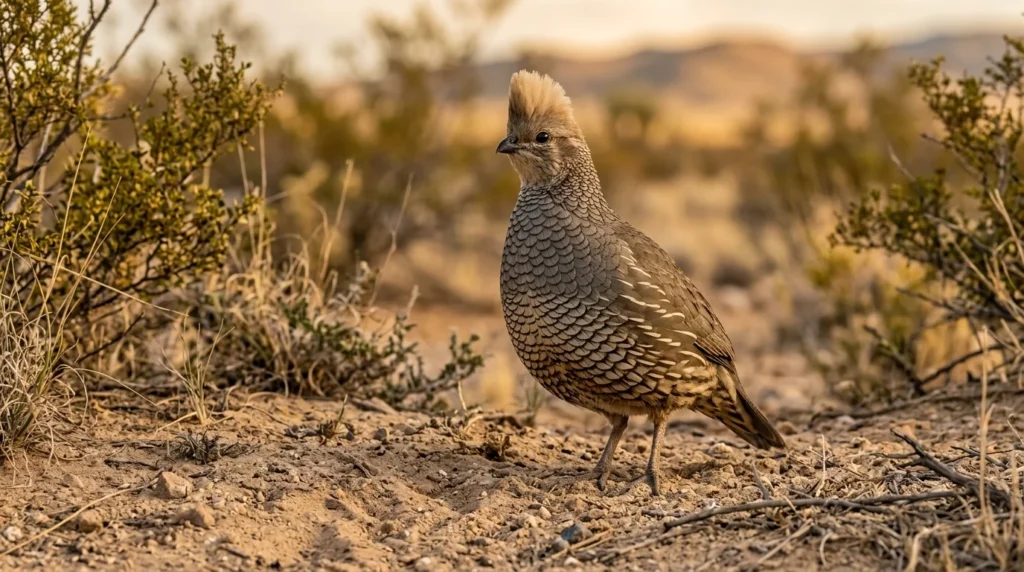
Blue Scale Quail, also called Scaled Quail, is identified by the distinct scale-like edging across its breast and back feathers, along with a pale, bushy crest that has earned it the nickname cotton-tops among hunters and keepers alike. It’s a genuine desert-southwest species, ranging across the arid Southwestern U.S. and into parts of Mexico, and its naturally secretive behavior makes it far harder to observe — and to source for keeping — than most other native quail.
The species is rare in native range and correspondingly difficult to obtain through normal hatchery channels, making it uncommon among keepers compared to Bobwhite or Gambel’s. Its range overlap with Bobwhite and range overlap with Gambel’s in parts of Texas, New Mexico, and Arizona is significant, since this shared territory is exactly where the wild hybrids discussed in a later section occur. Distinctive features include a cottontop crest, a plumage pattern built for camouflage across arid grassland range and broader southwestern U.S. distribution.
What Are Blue Scale Quail Behavior and Housing Needs?
Blue Scale Quail behavior centers on strong seasonal social structure: birds form social wintering groups roughly from September to April, then split off for pairing for breeding season once warmer weather arrives. In housing, they show a clear preference for dry sandy soil, reflecting their native desert habitat, and benefit from enrichment that supports natural dust-bathing behavior.
As layers, Blue Scale Quail are considered a good layer by wild-species standards, though their eggs come irregular rather than on the near-daily schedule of Coturnix, and are recognizable by their light-to-dark-brown spotted eggs. Because their range overlaps with both Bobwhite and Gambel’s, hybridization does occur in the wild, producing the informally named “blob” hybrid (Scaled x Bobwhite) and “scramble” hybrid (Scaled x Gambel’s) — terminology covered in more detail later in this guide. Wild lifespan runs short, roughly 8 months to 2 years, though captive birds that avoid predation typically do better; the species does mate for life and displays the same winter covey structure common to New World quail. Most keepers manage this species through a shared housing approach consistent with general New World quail guidance, and as with every other native species covered here, a Fish and Wildlife Service license is required to keep Blue Scale Quail legally in the U.S. Given how little captive-breeding data exists for this species compared to Bobwhite or Gambel’s, most successful keepers describe themselves as specialist keeper requirement cases who accept a real amount of trial and error, particularly around managing covey dispersal in spring as birds transition out of their winter grouping.
What Other Wild and Game Quail Species Should Farmers Know About?
A handful of other wild and game quail species come up regularly in farmer searches even though they aren’t among the core breeds most people keep — some because the name is a common alias for a breed already covered, and others because they’re genuinely rare specialist birds. Knowing which is which prevents wasted time chasing a “new” species that turns out to be a naming quirk, or underestimating how difficult a genuinely rare bird will be to keep.
The three species below round out the picture: one is simply another name for a breed already discussed at length, one is a popular game bird often confused for a true quail, and one is a regional name pointing back to a species covered later in this guide’s standalone topics section.
Is Egyptian Quail a Different Breed from Coturnix?
Egyptian Quail is not a different breed — it’s a historic alternate name for the standard Coturnix Quail, tied to the bird’s long history as a historic Egyptian food source and its spread along ancient Old World trade routes. Anyone searching egyptian quail looking for a distinct species will find, on closer inspection, that they’ve simply rediscovered Coturnix under an older label.
This kind of synonym clarification for SEO matters practically: hatcheries occasionally market specific Coturnix color lines under the “Egyptian” name, but the care, housing, and production figures are identical to any other standard Coturnix line covered earlier in this guide. For full detail on origins, identification, and care, the Coturnix section above covers everything relevant here.
What Does Raising Chukar Quail Involve?
Raising Chukar Quail involves caring for a hardy, rocky-terrain game bird that is commonly kept alongside true quail species despite being a different bird entirely. Alectoris chukar, to use its scientific name, is technically a red-legged partridge relative rather than a true member of either the Old World or New World quail genus — a distinction worth flagging clearly, since raising chukar quail searches often lump it in with genuine quail species out of habit rather than taxonomy.
In the wild, Chukar favors rocky hillside habitat, and in captivity it’s a genuinely popular hunting-dog training bird, filling a similar role to Bobwhite for handlers who want a strong-flying game bird for young dogs to point and flush. Because it’s distinct from true Old/New World quail genus members, care requirements lean closer to general upland game bird practices than to Coturnix or Bobwhite specifics, though housing space and predator-proofing needs are broadly comparable.
What Is Mearns Quail and Where Is It Found in Arizona?
Mearns Quail is not a separate species — it’s the regional common name used in Arizona for the Montezuma Quail, a genuinely rare and difficult species covered in full later in this guide’s standalone topics section. Searches for mearns quail arizona are best understood as local-search intent pointing at the same bird, just under its more commonly used field name in that state.
The species inhabits Arizona sky islands habitat and Madrean oak woodland, a narrow ecological niche that goes a long way toward explaining why it’s considered one of the extremely difficult captive care species in this entire guide. Because it’s the same species as Montezuma Quail, everything relevant to sourcing, behavior, and keeping difficulty is covered in that section rather than duplicated here.
How Do You Choose the Right Quail Breed for Your Goals?
Choosing the right quail breed comes down to ranking your goals honestly — meat, eggs, appearance, or companionship — and then picking the breed that performs best against that specific ranking rather than the breed that sounds most impressive on paper. Most buying mistakes in this hobby come from skipping this step and choosing based on looks or price alone, only to discover months later that the bird doesn’t fit the original reason for getting into quail at all.
The framework below breaks selection down by primary purpose, then answers the three questions people ask most often when comparing breeds directly: which is best overall, which is best for meat, and which is best suited to a backyard setup specifically.
How Should You Select a Quail Breed by Primary Purpose?
Selecting by primary purpose starts with naming your single biggest priority, because very few breeds genuinely excel at more than one thing. If you want a fun/colorful house pet, the Button Quail recommendation is hard to beat given its tiny size, indoor-friendly housing, and wide range of color varieties; if you want a fast-growing meat breed, the Coturnix recommendation — specifically a jumbo line — wins on growth speed and feed efficiency every time.
For keepers who want eggs for eating as the primary goal, standard Coturnix remains the strongest all-around choice thanks to its 250–300 eggs/year output, though the Bobwhite recommendation is worth considering for anyone who values flavor and doesn’t mind a slower timeline. Hunters and dog trainers drawn to Bobwhite’s exotic appearance and distinctive calls, or to Gambel’s for the same reasons, should treat the Gambel’s recommendation and Mountain Quail recommendation as fitting a fundamentally different goal — appearance and interest rather than food production. Running a fair meat production comparison across breeds means weighing both size and yield factors together, since a bigger bird isn’t automatically the better meat bird once feed cost and growth speed are factored in. For a consistent egg supply, Coturnix is the clear standout egg breed, while a feather sales purpose points keepers toward either Coturnix (for volume) or Button Quail (for decorative quality) depending on whether crafts, fly-tying, fashion, or accessories markets are the target — a niche closely tied to feather meal byproduct use in larger operations. It’s also worth noting that a genuine meat-production pairing with egg output is realistic mainly with Coturnix; most other breeds force a choice between the two.
On raw nutrition, the nutritional profile comparison between quail eggs vs chicken eggs shows quail eggs running higher in protein and micronutrients pound for pound, and there’s a reasonable yield similarity across breeds in that regard — the main variable is egg size variation by breed, since larger-bodied quail reliably produce larger eggs, regardless of species. Building a genuine purpose-first breed shortlist before buying anything, and thinking in terms of multi-purpose flock planning if you want more than one output from a single setup, will save real money and disappointment compared to buying first and figuring out the goal later.
What Is the Best Quail Breed?
The best quail breed overall, for the widest range of keepers, is the standard Coturnix Quail — it combines the fastest maturity, the highest egg output, the calmest temperament, and the lowest space and licensing burden of any species covered in this guide. That combination makes it the closest thing to an all-around best quail breed you’ll find, and it explains why the species dominates both commercial quail operations and backyard hobby flocks worldwide.
That said, “best” still depends on the ranking exercise from the previous section: Bobwhite wins on meat flavor and hunting-bird utility, Button Quail wins for tiny indoor spaces, and Gambel’s or Mountain Quail win on pure visual appeal. For a genuinely versatile beginner breed with strong overall keeper satisfaction, though, Coturnix remains the answer for the large majority of new keepers.
What Breed of Quail Is Best for Meat?
The best quail breed for meat is Jumbo Coturnix, thanks to its combination of fast growth, strong feed efficiency, and the heaviest realistic dressed weight comparison against any other farm-practical quail breed. Standard Bobwhite offers better flavor, but the meat yield per bird and processing age benchmark both favor Jumbo Coturnix by a wide margin — it reaches harvest weight in roughly half the time.
For anyone running numbers on feed costs, the meat quail feed ratio for Jumbo Coturnix compares favorably to nearly every other small livestock option, backyard poultry included. Bobwhite remains a legitimate choice specifically for keepers who value flavor over speed and don’t mind the added months to harvest weight, but on pure production economics, Jumbo Coturnix is the clear default recommendation.
What Is the Best Quail Breed to Raise in My Backyard?
The best quail breed to raise in a typical backyard is Coturnix, largely because it requires no special license, tolerates small enclosures well, and — critically for anyone with close neighbors — stays relatively quiet compared to crowing roosters or the loud calls of wild-type New World species. This makes it the default HOA-friendly quail keeping option for suburban and even some urban settings.
A small-footprint coop design built around Coturnix’s minimal space needs fits easily into a corner of a yard, garage, or even a spare room, and real noise considerations for neighbors favor this species heavily over Bobwhite or Gambel’s, both of which call loudly during breeding season. For anyone specifically researching urban backyard quail setup options, Coturnix consistently comes out as the practical answer — checking local ordinances first is still worthwhile, since some municipalities restrict poultry-keeping regardless of species.
How Do Climate, Space and Compatibility Affect Your Quail Breed Choice?
Climate, space, and compatibility between breeds all shape which quail species will actually thrive on your property, independent of whichever breed looks best on paper. A bird poorly suited to your winters, your available square footage, or your existing flock will underperform no matter how well it matches your stated purpose — so these three practical filters deserve a pass after purpose-based selection, not before.
The sections below cover cold tolerance by breed, minimum space requirements, and the frequently asked question of whether different breeds can simply be housed together.
How Should Climate Influence Your Quail Breed Selection?
Climate should influence quail breed selection primarily through cold tolerance, since this is where the breeds in this guide diverge most sharply. Running a straightforward cold tolerance comparison, Bobwhite cold-hardiness stands out as genuinely strong, making it well suited to regions with severe winter suitability requirements, while Coturnix cold-hardiness is solid but benefits more noticeably from supplemental shelter during hard freezes.
Most of the breeds in this guide show a reasonably adaptable climate range provided they’re given appropriate shelter appropriate to the season, but the real decision point is a climate-purpose-space tradeoff: a keeper in a harsh northern climate prioritizing egg volume might still choose Coturnix with a well-insulated coop over a “hardier” breed that underperforms on output. Watch for common heat stress signs — panting, wings held away from the body, reduced feed intake — during summer, and invest in genuine cold-weather coop insulation rather than relying on breed hardiness alone; even the most cold-tolerant quail breed benefits from a basic regional breed suitability map check against your specific winter lows before committing to outdoor housing.
How Much Space Do You Need for Different Quail Breeds?
Space needs vary dramatically by breed, with Coturnix requiring the least space requirement of any species in this guide at as little as 1–2 square feet per bird, making it the natural choice for limited-room suitability setups. By contrast, every New World species — Bobwhite, California, Gambel’s, and Blue Scale — needs roughly 4 sq ft per adult bird, a fourfold difference that should factor heavily into any final breed decision if space is genuinely tight.
This gap isn’t just about total square footage; it also reflects real differences in tight-quarters tolerance, since Coturnix has been selectively bred for generations to handle dense housing without the stress responses that trigger injury in wilder species. For keepers working with a small footprint, appropriate stocking density guidelines and thoughtful enrichment for confined quail — perches, dust-bath areas, visual barriers — matter more than raw square footage alone, but the baseline space requirement still needs to be respected regardless of how well an enclosure is enriched.
Can You Mix Different Breeds of Quail?
Generally, no — mixing different breeds of quail in the same enclosure is not recommended, for both behavioral and hybridization reasons. Species like Bobwhite and Gambel’s show real territorial and pair-bond aggression even within their own species, and adding an unfamiliar species to the mix compounds that cross-species aggression risk substantially.
There’s also a genuine disease transmission between breeds concern, since different species can carry and tolerate pathogens differently, and a separate-pen best practice protects both breeds from health issues that might pass unnoticed in one species while causing serious illness in another. Hybridization is the other major factor: wild Blue Scale, Bobwhite, and Gambel’s populations do interbreed where their ranges overlap, producing the informally named “blob” and “scramble” crosses covered in detail later in this guide — interesting from a natural-history standpoint, but not something most keepers want to reproduce deliberately in a managed flock, since hybridization outcomes are unpredictable in both appearance and temperament.
What Factors Drive Egg Production and Successful Quail Keeping?
Once you’ve chosen a breed, egg production depends far more on how the flock is managed than on genetics alone. Nutrition, lighting, housing, water, stress, age, weather, and incubation quality all interact, and even the most productive Coturnix hen will underperform in a poorly managed setup, while a moderately productive breed can reach the top of its range with disciplined, consistent care.
The habits that keep a flock productive are simple but easy to neglect: start with healthy breeding stock, keep housing clean, collect eggs daily, never let water run out, and avoid sudden stress or changes in routine. For the full breakdown of protein requirements, lighting schedules, and seasonal management, see our complete quail feeding guide and our complete quail egg guide.
What Other Quail Topics Should Serious Keepers Understand?
A handful of standalone topics don’t fit neatly into any single breed profile but come up often enough among serious keepers to deserve direct coverage — two genuinely rare specialist species, an explanation of wild hybrid naming, the methodology behind egg-production rankings used throughout this guide, and a closer look at selecting breeds specifically for feather sales.
Each of these rewards a keeper who wants to go beyond the basics covered in the main breed sections above.
What Should You Know About Mountain Quail?
Mountain Quail is the largest native U.S. quail species, weighing in at 189–262 g (6.7–9.2 oz), and ranges across California, Oregon, Nevada, and a northern Baja California subspecies further south. It’s a genuinely striking bird, but it is emphatically not recommended for beginners — captive breeding presents real, documented difficulty at nearly every stage.
The core challenge is difficult chick-starting: in the wild, Mountain Quail chicks receive extended parental feeding, a level of care that’s hard to replicate artificially, and highly skittish adults combined with real disease susceptibility compound the difficulty further. Native to elevations up to 3,000 m (9,800 ft), the species is identified by a long slender head plume, with sexing by plume differences — females show a shorter, browner plume and a brown head extension, while males display a grey-blue nape. Housing follows Bobwhite/Gambel’s-style guidance, since the species similarly tends to mate for life in pairs at 4 sq ft/bird; it is not raised for meat, existing instead purely for its ornamental value, and a Fish and Wildlife Service license is required to keep it in the U.S. For anyone drawn to the scientific side, Oreortyx pictus inhabits genuine sky-island habitat in parts of its range, making this realistically a specialist aviculturist project rather than a casual addition to an existing flock.
What Are "Blob" and "Scramble" Quail Hybrids?
“Blob” and “scramble” are informal field names for two naturally occurring wild quail hybrids, not officially recognized breeds or scientific classifications. The “blob” hybrid term refers specifically to a Blue Scale x Bobwhite cross, while the “scramble” hybrid term describes a Blue Scale x Gambel’s cross — both arising naturally where these species’ overlapping wild ranges meet in the American Southwest.
This kind of colloquial hybrid naming reflects genuine wild hybridization zones where species boundaries blur under natural conditions, a phenomenon of real interest to biologists studying species-boundary blurring in game birds. Modern citizen-science reporting of hybrids has helped researchers track how common these crosses actually are across the shared range of these three species, though they remain uncommon enough that spotting one in the wild is still considered a notable sighting.
How Is Egg-Production Ranking Determined Across Breeds?
Egg-production rankings across breeds in this guide are built on a consistent multi-factor ranking framework rather than a single number, since annual egg count alone can be misleading without context. The core metrics include annual output, first-lay age, egg size, feed efficiency, breeding ease, beginner suitability, and incubation success — combined into a single breed comparison methodology that reflects real-world usability, not just theoretical maximum production.
This kind of weighted scoring model is useful for any keeper building their own decision process, and a simple breed-comparison spreadsheet approach — listing each breed against these seven metrics — makes it far easier to compare candidates objectively than relying on marketing claims from a single hatchery.
How Should You Choose a Breed for Feather Sales?
Choosing a breed for feather sales means evaluating plumage quality and feather size as a distinct selection criterion, separate from meat or egg output entirely. This feather-quality selection angle points keepers toward either high-volume Coturnix for bulk feather harvest, or toward smaller, more decoratively marked species like Button Quail when fine, uniquely patterned feathers matter more than sheer quantity.
Feathers collected this way serve real markets in crafts use, fly-tying use, and fashion use — a genuinely distinct from meat/egg purposes business angle that some small farms run as a side revenue stream alongside their primary production goal. For anyone pursuing this seriously, learning proper feather harvesting technique avoids stressing or injuring birds during collection, understanding the difference between natural vs dyed feather use matters for pricing, and building relationships within fly-tying material sourcing communities is often the most reliable way to find consistent buyers.
Which Quail Breeds Win on Appearance, Temperament and Rarity?
Some breed comparisons don’t map neatly onto purpose, climate, or space — they’re really about which bird wins on a single standout trait. The three questions below are among the most commonly searched breed-comparison queries, and each has a fairly clear answer once you look at the full lineup covered in this guide.
What Is the Most Beautiful Quail?
The most beautiful quail, by most keepers’ consensus, is a close contest between California Quail and Mountain Quail, both prized specifically for their striking head plumes and overall plumage quality. California Quail earns its reputation as beautiful but unproductive, while Mountain Quail’s ornamental value makes it the natural second anchor for this comparison.
Beyond these two, a broader ornamental plumage ranking would also weigh head-plume comparison across Gambel’s and Mountain Quail specifically, since both carry distinctive plume shapes that set them apart from the plainer Coturnix or Bobwhite profile. For keepers focused specifically on color-variety show quality, a well-bred Coturnix color line — Celadon, Rosetta, or Tibetan among them — can rival either species in visual interest, just within a much smaller, less plumed body.
What Is the Friendliest Quail?
The friendliest quail is Coturnix, by a wide margin — its docile, tame, and often genuinely “snuggly” temperament stands in sharp contrast to the skittishness of most New World species. This contrast becomes obvious the moment you compare Coturnix directly against Bobwhite or Gambel’s, both of which startle and flush far more readily even after generations in captivity.
That gap is largely explained by domestication history: Coturnix has been selectively bred for calm behavior for far longer than any New World species has been kept in captivity at all. A useful mental model here is hand-tamed chick imprinting — early handling shapes adult temperament significantly, but it can only work with a breed genetically predisposed toward calmness in the first place, which is exactly why a rough docility ranking by breed consistently places Coturnix at the top and explains the dramatically different low-stress handling comparison results between it and species like Bobwhite or Gambel’s.
What Is the Most Expensive Quail Breed?
The most expensive quail breed, in practical terms, tends to be whichever rare species is hardest to source at a given time — most often Montezuma Quail or Blue Scale Quail, both of which carry significant scarcity and difficulty premiums rather than one having a fixed, universally higher price than the other. Montezuma Quail’s documented rarity and general difficulty to obtain, alongside Blue Scale Quail’s own well-established scarcity, make both breeds the strongest anchors for this comparison rather than any single common species.
Pricing in this hobby follows predictable rare-species premium pricing logic: the harder it is to find hard-to-source breeding stock, the more a serious buyer should expect to pay, and this same dynamic extends to specialty Coturnix color lines, where a specialty color-variety premium can apply even within an otherwise inexpensive and widely available species.
Frequently Asked Questions
Which Quail Breed Lays the Most Eggs?
Coturnix Quail lays the most eggs of any commonly kept breed, with the highest-producing lines reaching 250–300+ eggs annually under good lighting and nutrition. No other breed covered in this guide comes close to matching that output on a per-bird, per-year basis.
Are Jumbo Coturnix Quail Good Egg Layers?
Yes — Jumbo Coturnix Quail remain solid egg layers, producing large egg numbers even though the strain was primarily developed for improved meat production. Output runs only modestly below a standard Coturnix comparison line, making Jumbo Coturnix a genuinely realistic dual-purpose choice rather than a meat-only bird.
How Long Does It Take Quail to Start Laying Eggs?
For Coturnix Quail, also known as Japanese Quail, laying typically begins at six to eight weeks of age — faster than any other domesticated poultry species kept in North America. Other breeds vary considerably, with most New World species taking several months longer to reach the same milestone.
Can Quail Lay Eggs Year-Round?
Yes, quail can achieve year-round laying given proper nutrition and adequate lighting, specifically 14–16 hours of daily light. Without supplemental lighting, most breeds slow or stop laying as natural daylight hours shorten through fall and winter.
What Is the Best Quail Breed for Beginners?
Coturnix Quail is the best quail breed for beginners, combining status as the easiest breed to manage with recognition as the most productive breed for both eggs and meat. Its overall beginner suitability — fast maturity, calm temperament, minimal space needs, and no license requirement — makes it the clear starting point for anyone new to quail keeping.
© 2026 Homestead Quail. All rights reserved.
Homestead Quail
Practical, question-first guides for raising healthy,
productive quail —from first egg to full coop.
TOPICS
Farming
Breeds
Care
Feed
MORE
Housing
Incubation
Eggs
SITE
About
Contact
Privacy Policy