
EGG PRODUCTION & QUALITY CARE
Fresh Quail Eggs: Collection, Quality & Handling
Learn best practices for harvesting speckled quail eggs, maintaining shell integrity, proper cold storage, and preparing high-value culinary eggs.
300+
Eggs / Hen / Year
10-12g
Average Egg Weight
55-60°F
Ideal Storage Temp
3-5 Weeks
Fresh Shelf Life
What Are Quail Eggs, and Why Do They Deserve a Closer Look?
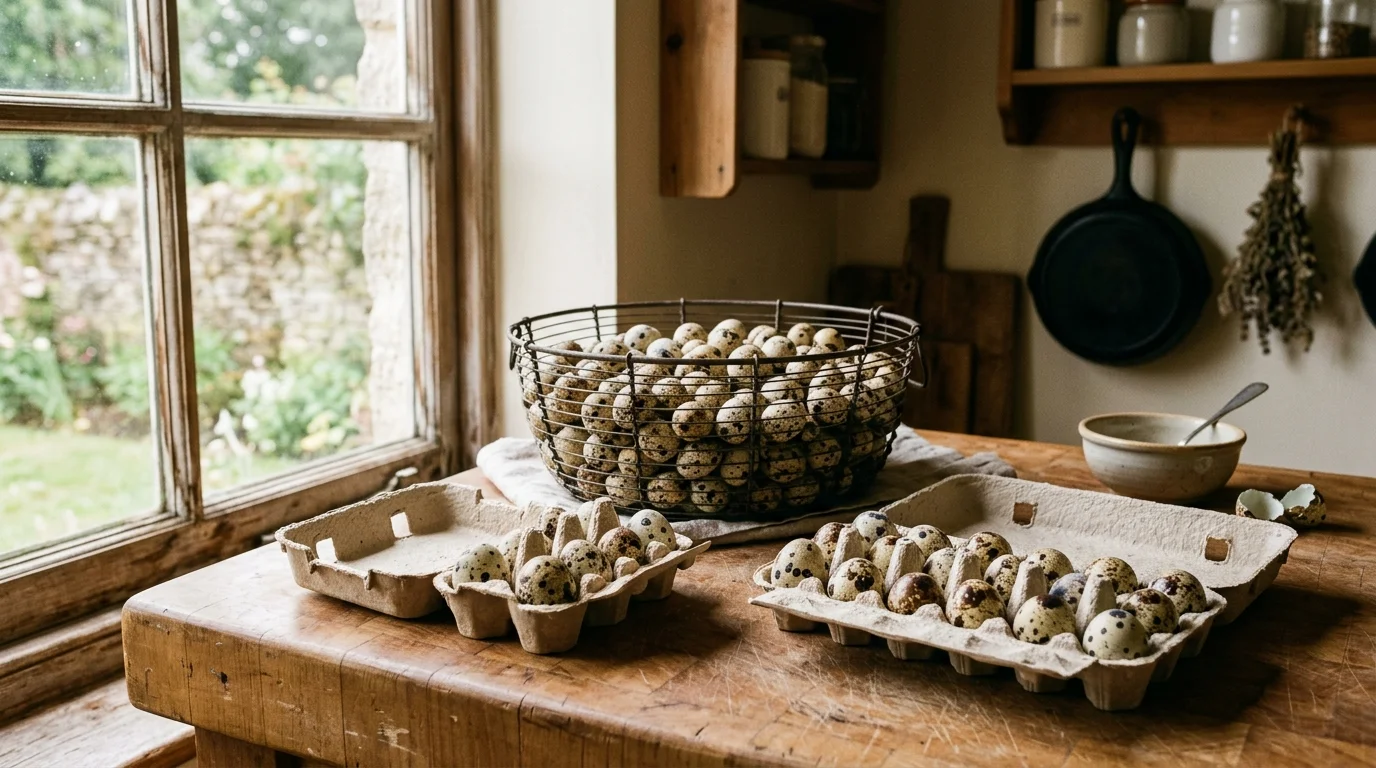
Quail eggs are the small, speckle-shelled eggs laid by domesticated quail, most commonly the Coturnix japonica breed, and they pack a disproportionate amount of nutrition into a shell roughly one-fifth the size of a chicken egg. Coverage from outlets like Delve Experiences, WebMD, and Healthline once treated them as a novelty item best known for garnishing charcuterie boards or turning up at Texas farmers markets in cartons stacked next to duck and chicken eggs. That framing has aged poorly. Quail are medium-sized birds native to parts of Europe, North Africa, and Asia, and while wild populations still range across those regions, commercial quail-egg production has taken firm root in the southern U.S., where warmer climates and lower overhead make small-scale quail operations easier to run than large chicken layer houses.
What actually distinguishes a quail egg on sight is its cream-colored shells mottled with dark brown speckling — no two eggs from the same hen look quite identical — wrapped around deep-yellow yolks that taste noticeably richer than their chicken counterparts. That richness isn’t just a culinary quirk; it reflects a genuinely nutrient-dense composition that has pulled quail eggs out of the novelty aisle and into conversations about superfood status, a term nutrition writers use cautiously but which the American Egg Board and independent researchers alike acknowledge has some basis given the eggs’ micronutrient density. Framed as an all-natural protein source, quail eggs are increasingly marketed around weight management, muscle strength, brain function, and eye health — claims this guide will hold up against the actual data rather than take at face value. Everything that follows, from how quail actually lay these eggs to how you should candle, store, cook, and eat them, is built around one goal: giving you the collection, quality, and handling knowledge that the novelty-item framing never bothered to cover.
How Does Quail Egg Production and Laying Actually Work?
Quail egg production runs on a much faster, more compressed cycle than chicken egg production, which is exactly why backyard keepers and small commercial operations gravitate toward quail in the first place. A hen that reaches maturity in under two months and lays nearly every day for most of the year behaves very differently from a flock you manage around a slower chicken timeline, and understanding that rhythm — species differences, daily and annual output, feeding needs — is the foundation for everything else in this guide, including the collection and freshness-testing practices covered in the next two sections. Species matters more than most first-time keepers expect. Coturnix coturnix japonica, commonly shortened to Coturnix japonica, is the workhorse breed behind nearly all commercial and backyard quail-egg operations because it was selectively bred for rapid growth and heavy laying rather than for meat or ornamental traits. Bobwhite quail, by contrast, are a North American native game bird species kept mostly for conservation, hunting-preserve release, or meat, and while bobwhite hens do lay eggs, their output and domestication level fall well short of Coturnix — a distinction worth knowing before you buy stock expecting chicken-egg-style production from the wrong bird.
When Do Quail Start Laying Eggs?
Quail reach point of lay remarkably early, typically between six and eight weeks of age, compared to the four-to-five-month wait most chicken breeds require. This accelerated timeline is a direct product of the selective breeding that shaped Coturnix japonica into a commercial layer, and it’s the single biggest reason quail appeal to keepers who want a fast return on their investment. Photoperiod — the number of daylight hours a hen experiences — is the trigger that switches on laying; birds hatched in shorter winter daylight may lag behind the six-to-eight-week window until day length (natural or supplemented with artificial lighting) reaches roughly 14 to 16 hours. Bobwhite quail mature on a similar physical timeline but are far less reliable layers under the same conditions, since they were never bred for the same laying intensity.
How Many Eggs Does a Quail Lay Per Day and Per Year?
A healthy, well-lit Coturnix hen lays close to one egg per day, translating to roughly 250 to 300 eggs annually under good management — a lay rate that rivals or exceeds many commercial chicken breeds relative to body size. Whether that production holds up year-round depends almost entirely on light: hens kept under a stable 14-to-16-hour photoperiod, natural or supplemented, will keep laying through winter, while flocks left on natural daylight alone typically slow down or pause once day length shortens in the fall. Quail typically lay in the late afternoon or early evening rather than the morning pattern chickens follow, which changes when you should actually walk out to collect eggs. Unlike chickens, Coturnix hens have had broodiness almost entirely bred out of them, so they rarely sit on or incubate their own eggs; anyone planning to hatch quail chicks needs an incubator rather than a hen. A small number of speciality lines carry a genetic mutation that produces quail that lay blue eggs, a novelty trait unrelated to nutrition or fertility but frequently asked about by new keepers who spot an odd-colored egg in the nest box. When lay rate drops off unexpectedly, the most common culprits are age (hens naturally decline after 12 to 18 months and are often designated cull hens once production falls), stress, inadequate light, or a reproductive issue such as egg-bound obstruction in the oviduct, which requires prompt attention since it can be fatal if untreated.
What Should You Feed Quail to Support Egg Laying?
Consistent egg production depends on a purpose-built layer ratio — typically 20 to 22 % protein for a straight layer feed or 18 to 20 % for a breeder ration, along with balanced calcium and vitamin D3 — noticeably higher protein than standard chicken layer feed, reflecting quail’s faster metabolism and egg-to-body-weight ratio. Underfeeding protein or calcium shows up quickly as thinner shells or a stalled lay rate, which is why experienced keepers treat feed formulation as a laying issue, not just a general husbandry one. Our quail feed guide covers protein by life stage, calcium and grit in full. It’s also worth being upfront about the disadvantages of quail farming here: quail are flighty, prone to injuring themselves against enclosure tops, and their small size makes manual egg collection and cleaning genuinely more labour-intensive per dozen than chicken eggs — trade-offs that are easy to underestimate before you actually start.
How Should You Collect and Clean Quail Eggs?
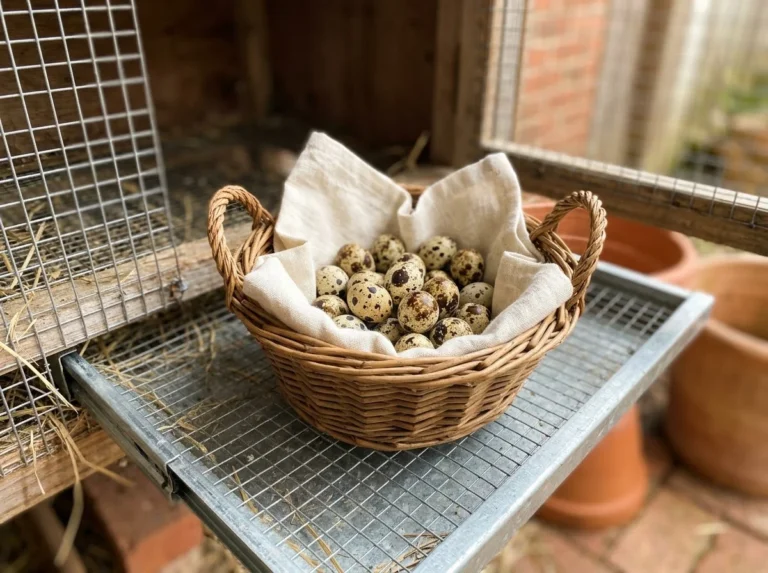
Fresh quail eggs should be collected on a consistent schedule and cleaned using either a dry-brush method or a careful wet-wash — never both carelessly combined — because the wrong technique strips away the egg’s natural protective barrier and increases contamination risk rather than reducing it. Because quail eggs are laid on the coop floor or in a shallow nest box rather than a raised box like chickens use, they sit closer to bedding, droppings, and moisture, which makes a disciplined collection schedule more important for quail than for almost any other backyard poultry.
Every fresh egg is coated in a natural, nearly invisible layer called the bloom, or cuticle, which seals the thousands of microscopic pores in the shell and forms the egg’s first line of defense against bacteria. Collecting eggs into a clean egg basket at least once or twice daily — more often in warm weather — minimizes the time eggs spend in contact with a dirty nest box before that bloom can do its job. Because quail are ground-layers with minimal nesting behavior, a surprising number of eggs will have visible debris on them by the time you reach them, which is exactly the scenario the next two questions address.
How to Clean Quail Eggs Before Eating
The safest way to clean a quail egg is the dry-cleaning method — gently brushing or wiping off surface debris with a dry cloth or fine sandpaper-style egg brush — because it leaves the protective bloom intact. When an egg is too soiled for dry cleaning, the wet-washing method becomes necessary: use water noticeably warmer than the egg itself (cold water can pull bacteria through the porous shell and into the egg via thermal contraction) along with a mild, food-safe sanitizing solution, then dry the egg immediately. Wet-washed eggs lose their bloom in the process, which means they must go straight into the refrigerator afterward. Washing your own hands before and after handling raw eggs, and disinfecting any surface the eggs touched, is the other half of avoiding cross-contamination in your kitchen.
Should Fresh Quail Eggs Be Washed After Collection?
Not automatically — visibly clean eggs are generally better left unwashed so the bloom stays intact, preserving a longer safe shelf life at room temperature before immediate refrigeration becomes necessary. This is essentially the same logic USDA guidance applies to commercially graded chicken eggs, where washing is standardized precisely because it strips the cuticle and creates a hard refrigeration requirement; a home flock keeper following a tight collection schedule can often skip washing entirely for eggs that come out of the nest clean. The tradeoff is one of contamination risk versus convenience: an egg that looks clean today can still carry surface bacteria you can’t see, so if you’re producing eggs intended for immediate sale or for a household with an at-risk member, applying a light wash and refrigerating promptly — effectively meeting the same standard reflected in a USDA freshness grade — is the more conservative choice.
How Can You Test Whether a Quail Egg Is Still Fresh?
You can confirm a quail egg’s freshness at home using three simple, low-cost checks — a float test in water, candling with a bright light, and a final sniff test after cracking — and running all three together is more reliable than trusting any single method on its own. Because quail eggs have a thicker shell-to-content ratio than chicken eggs, some of the visual cues take slightly more practice to read correctly, which is why this section walks through each test individually rather than treating “check if it’s fresh” as a single step.
How to Tell If a Quail Egg Is Still Good (Freshness Test)
The most direct freshness test is cracking the egg onto a flat plate and evaluating egg white viscosity and yolk position: a fresh egg holds a thick, gelled white close around a yolk that sits high and round, while an aging egg spreads into a thin, watery puddle with a flattened yolk. A quick sniff test immediately after cracking is your final confirmation — any sulfurous or off odor means the egg is not safe to eat, regardless of how it looks. Spoilage signs rarely appear in isolation; a genuinely bad egg will usually fail more than one of these checks at once, whereas a slightly older but still safe egg might just show minor egg white viscosity loss without any smell, which lines up with the USDA freshness grade system’s approach of scoring eggs on a spectrum rather than a strict pass/fail.
What Does It Mean If a Quail Egg Floats? (The Float Test)
A floating quail egg means it has aged enough for its internal air cell to expand, not that it is automatically spoiled. In the float test, you submerge the egg in a bowl of water: a very fresh egg sinks and lies flat on its side, a few-weeks-old egg tilts upright but stays submerged, and an older egg floats due to increased buoyancy from gas that has built up inside as moisture evaporated through the shell over time via water displacement test physics. Because air cell size grows steadily and predictably, the float test functions as a reasonably accurate egg age indicator, but a floating egg still deserves a follow-up sniff test before you write it off — floating tells you the egg is old, not necessarily unsafe.
| What the egg does in water | What it means |
|---|---|
| Sinks and lies flat on its side | Very fresh |
| Sinks but tilts upright | A few weeks old |
| Floats | Older: the air cell has expanded. Do a sniff test before discarding |
How to Candle Quail Eggs: Signs of a Bad Egg
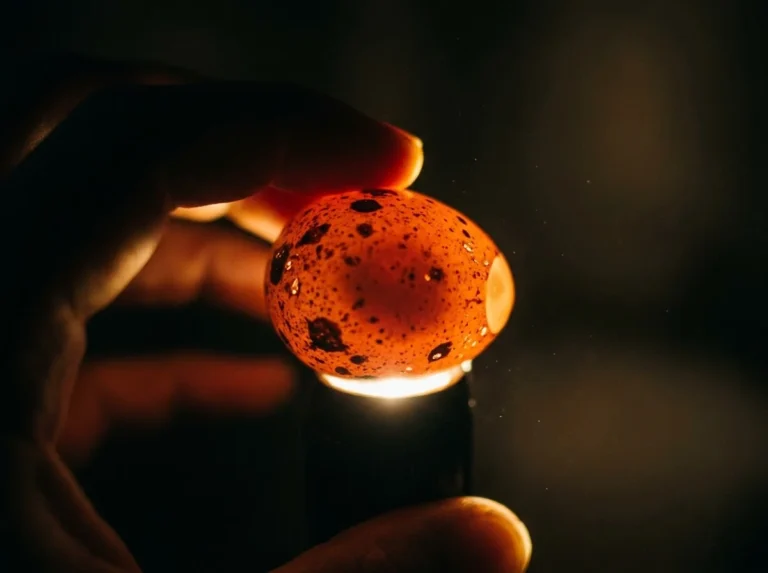
Candling — holding the egg in front of a bright light source such as a dedicated candling lamp in a darkened room — lets you see straight through the thin shell to check internal structures without cracking the egg open. A healthy egg shows a small, stable air cell at the wide end, a centred yolk position with a faint, cohesive shadow, and no unusual marks; a bad egg reveals blood ring formations, dark discolouration, or a yolk that swims freely around the shell when rotated, all of which count as clear spoilage signs. Candling fertile eggs for hatching works the same way but looks for different things — our quail incubation guide covers when to candle and what a developing embryo looks like.
Why Do Quail Egg Shells Develop Quality Problems?
Soft, thin, or occasionally missing shells almost always trace back to a nutritional or environmental gap rather than a genetic flaw you can’t fix, and identifying which factor is at play lets you correct it within days rather than guessing indefinitely. Because a quail eggshell is already thinner and more fragile than a chicken eggshell by design, even a mild deficiency shows up faster and more dramatically in a quail flock than it would in chickens eating the same imbalanced diet.
Why Are Quail Egg Shells Soft or Thin? Common Causes
The leading cause of soft or thin shells is calcium deficiency, often compounded by insufficient vitamin D3, since vitamin D3 is what allows a hen’s body to actually absorb and deposit the calcium she eats into shell material. Supplementing the diet with a crushed oyster shell supplement on top of a complete layer ration resolves most calcium-related cases within one to two weeks, the typical span of a full shell-formation cycle. Heat stress is the second major driver — hens under prolonged high temperatures eat less overall (reducing calcium intake) while also pulling more calcium out of circulation for temperature regulation, a combination that produces classic thin shell syndrome even on an otherwise adequate diet. Age and genetics and shell strength play a smaller but real role too: some individual hens and bloodlines simply produce weaker shells regardless of nutrition, and older hens nearing the end of their productive cycle often show gradually thinning shells as a natural decline. True shell-less eggs — a yolk and white wrapped only in membrane, no calcified shell at all — usually indicate a more acute, single-event disruption in the reproductive tract rather than an ongoing dietary problem, and a hen producing them repeatedly should be evaluated rather than assumed to just need more calcium.
How to Handle Fragile, Thin-Shelled Quail Eggs
Handle any batch of unusually fragile eggs the way you’d handle a carton of eggs you already know are compromised: collect on a tighter collection schedule to reduce time in the nest where other hens can step on them, and use egg carton padding — foam or extra paper liner — rather than a bare plastic carton. Breakage prevention at this stage is mostly about reducing handling steps: collect directly into the storage container you intend to keep the eggs in, rather than transferring them between multiple containers, since every transfer is another chance for a hairline crack to become a full break.
How Big Are Quail Eggs, and What Do They Actually Look Like?
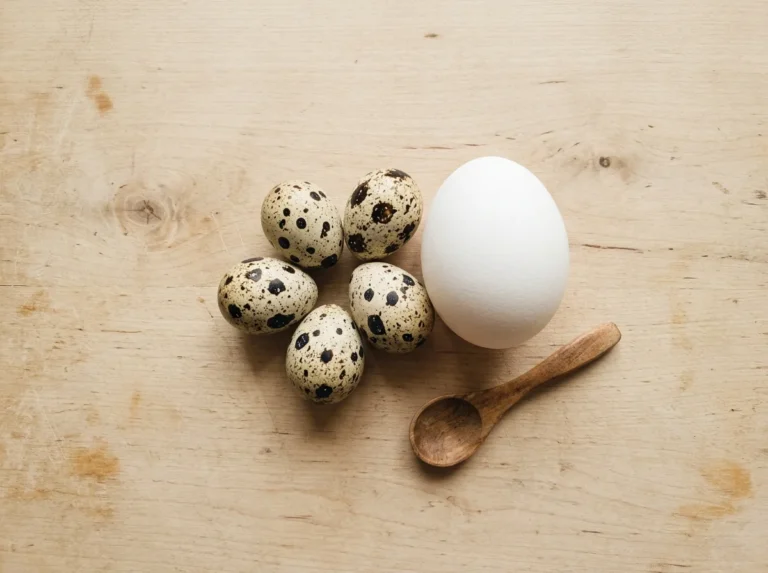
A typical quail egg weighs about 9 grams and measures roughly an inch long, making it around one-fifth the size of a large chicken egg by weight, with a signature cream-colored, dark-speckled shell that varies slightly from hen to hen. Both size and appearance are genuinely useful diagnostic tools, not just trivia — a sudden shift in either one is often the first visible sign that something in the flock’s diet, age, or environment has changed.
How Big Are Quail Eggs? (Size, Weight & Comparisons)
Individual quail eggs generally fall in a narrow band around 9 to 10 grams, compared to roughly 50 to 60 grams for a large chicken egg — meaning it genuinely takes three to four quail eggs to match one chicken egg by volume in a recipe, a ratio referenced repeatedly later in this guide. Most commercial and hobbyist grading systems apply a simple weight-based grading approach rather than the more elaborate size categories used for chicken eggs, since the practical size range within a healthy quail flock is fairly narrow. The eggs themselves have a more pronounced ovate shape — noticeably more tapered at one end — than the rounder profile of a chicken egg, which is partly why they nest and stack differently in cartons designed for larger eggs.
What Color Should Quail Eggs Be?
A normal quail egg shows a cream-colored shell background covered in an irregular speckle pattern of dark brown blotches, with shell pigmentation that is genuinely unique to each individual hen, similar to a fingerprint. As mentioned earlier, a small number of specialty genetic lines produce blue quail eggs, a breed-dependent trait that’s perfectly normal within those lines and not a sign of illness or poor nutrition. What should raise a flag is a sudden, flock-wide shift toward pale, washed-out, or unusually uniform shells with little to no dark brown speckling — that kind of abrupt change points toward the same nutritional or heat-stress issues covered in the shell-quality section above, rather than a normal appearance variant.
How Long Do Quail Eggs Last, and How Should You Store Them?
Unwashed quail eggs with their bloom intact can safely sit at cool room temperature for roughly one to two weeks, but refrigerated storage extends that window to several weeks and is the safer default for most households. Storage guidance genuinely differs depending on whether an egg is raw and unwashed, raw and washed, or already cooked, which is why lumping “how long do quail eggs last” into one blanket answer causes most of the confusion people run into.
| Egg type | Where to keep it | How long it lasts | Note |
|---|---|---|---|
| Raw, unwashed (bloom intact) | Cool room temperature | About 1–2 weeks | Shorter in a hot or humid kitchen; never for washed eggs |
| Raw eggs | Refrigerator | About 3–5 weeks | Mandatory once an egg has been wet-washed |
| Hard-boiled | Refrigerator | 3–5 days | Cooking removes the shell's natural defenses |
| Pickled | Refrigerator | Several weeks | Soak at least 48 hours first; always keep cold |
How Long Do Quail Eggs Last on the Counter Unwashed?
An unwashed quail egg can generally last around one to two weeks at stable, cool room-temperature storage before quality noticeably declines, thanks entirely to the intact bloom sealing the porous shell against bacteria and moisture loss. That window shrinks considerably in a hot kitchen or humid climate, and it disappears the moment the egg has been washed, since washing strips the bloom and turns ambient storage into a food-safety risk rather than just a freshness one. Commercial food-safety authorities in the U.S. don’t actually endorse counter storage for retail eggs at all — this guidance applies specifically to unwashed eggs straight from a home flock, not eggs you’ve bought from a store.
Do Fresh Quail Eggs Need to Be Refrigerated?
Refrigeration isn’t strictly mandatory for unwashed, bloom-intact quail eggs in the short term, but it is the safer and longer-lasting choice, and it becomes mandatory the moment an egg has been wet-washed. Once eggs go into the fridge, the refrigerator crisper drawer or a dedicated egg tray keeps them at a stable, moderate humidity rather than the drying draft near the door, extending freshness further. USDA storage guidelines for chicken eggs — refrigerate promptly, maintain a consistent cold chain, avoid temperature swings — apply just as sensibly to quail eggs even though quail aren’t covered by the same formal grading regulations.
How Long Do Quail Eggs Last in the Fridge?
Refrigerated raw quail eggs typically stay good for 3 to 5 weeks, roughly comparable to chicken eggs on a per-week basis once you account for their smaller size and slightly different shell porosity. That’s meaningfully longer than the 3 to 5 days shelf life you’ll see quoted elsewhere in this guide for already hard-boiled quail eggs — the two numbers get mixed up constantly online, but they describe different products at different stages, not the same egg. Clear egg carton labeling with the collection date is the simplest way to track this window accurately, since quail eggs don’t carry a printed sell-by date the way store-bought chicken eggs do.
How to Store and Preserve Quail Eggs?
Beyond basic refrigeration, quail eggs can be preserved longer-term through pickling, or by freezing (whole vs. separated) — cracking eggs into a container to freeze rather than freezing them in the shell, since a frozen shell will crack. Maintaining stable humidity control in your storage area, whether that’s a refrigerator crisper or a root cellar,meaningfully slows moisture loss through the shell regardless of which
preservation method you choose. Vacuum-sealing cooked or pickled quail eggs before refrigeration or freezing adds another layer of protection against oxidation and off-flavors, particularly useful if you’re storing eggs in bulk after a productive collection week.
How Much Do Quail Eggs and Live Quail Actually Cost?
Fresh quail eggs typically cost several times more per egg than chicken eggs, and live quail themselves are inexpensive as day-old chicks but climb quickly in price for proven adult layers or specialty breeder stock. Both prices trace back to the same root economics: quail are cheap and fast to raise, but the eggs are labour-intensive to collect, clean, and sell in a market that’s still fundamentally a niche compared to chicken eggs.
How Much Do Quail Eggs Cost?
Retail quail eggs commonly run somewhere in the range of a per-dozen pricing of roughly $6 to $10 at farmers markets, speciality grocers, and online retailers in the U.S., though prices vary meaningfully by region and by whether the eggs are fresh, jarred, or canned. That price reflects a farmgate price paid to small producers that’s already higher per egg than what chicken egg farmers receive, compounded by a retail markup applied at every step from farm to shelf. Because a producer needs roughly three to four quail eggs to equal the food volume of one chicken egg, the effective cost-per-meal gap is even larger than the per-dozen sticker price suggests.
How Much Does a Quail Cost? (Live Birds & Chicks)
Day-old Coturnix quail chicks typically sell for just a few dollars each, while proven adult laying hens or specialty breeder stock cost noticeably more, often in the range of $10 to $25 per bird depending on the line and whether it’s already at point of lay. An adult Coturnix quail generally weighs between 100 and 300 grams depending on sex and strain, information that matters for anyone calculating feed costs or shipping weight when buying breeder stock online. Because quail reach point of lay so quickly, the total cost of raising a chick to its first egg is genuinely lower than doing the same with chickens, even though the per-bird purchase price for premium breeding stock can look comparable at first glance.
Where to Buy Quail Eggs?
Fresh and preserved quail eggs are most reliably found at Asian grocery stores, natural food stores, and farmers markets, with online retailers filling the gap for buyers outside major metro areas. Many retailers carry jarred quail eggs or canned quail eggs as a shelf-stable alternative to fresh, which according to Healthline and WebMD should be given a quick rinse before use even though the preservation liquid is already food-safe. The combination of being harder to find than chicken eggs and genuinely expensive relative to their size is exactly why quail eggs have retained something of a luxury item positioning in Western grocery stores, even as everyday demand has grown.
What Is the Actual Nutrition Profile of Quail Eggs?
A single quail egg delivers about 14 calories, roughly 1 gram of protein, and a concentrated dose of several B vitamins and trace minerals relative to its tiny size — the kind of micronutrient density that explains most of the “superfood” talk surrounding them. Because one egg is such a small unit, the numbers only become meaningful once you compare them per gram or scale them up to a full serving, which is exactly what the next three sections do.
What's the Nutritional Composition of a Single Quail Egg?
At roughly 9 grams, a single quail egg contains about 14 calories, 1 gram of protein, 1 gram of fat, and effectively no carbohydrates or fiber, according to USDA FoodData Central data cited by both WebMD and Delve. Despite the small totals, that one egg still supplies meaningful percentages of several nutrients on a Daily Value (%DV) basis: roughly 4% DV choline, 6% DV riboflavin, 2% DV folate, 3% DV pantothenic acid, 2% DV vitamin A, 6% DV vitamin B12, 2% DV iron, 2% DV phosphorus, and 5% DV selenium. Several of these — choline in particular, which the body converts into acetylcholine production for nerve signaling, along with B12’s role in red blood cell formation and nervous-system function, and riboflavin’s contribution to energy metabolism and thyroid function — are exactly the micronutrients most closely tied to the brain-function and energy claims made about quail eggs, giving those claims more grounding than the marketing language alone would suggest.
What Is the Serving-Size Equivalence to a Chicken Egg?
Most recipe conversions treat three quail eggs as roughly equivalent to one chicken egg, though some cooks round up to three to four quail eggs depending on the dish and how forgiving the recipe is about slight volume differences. This equivalence matters most in baking, where egg volume affects structure, and less in dishes like fried or poached eggs where you’re simply serving multiple small eggs instead of one large one. Healthline and WebMD both frame a realistic serving size for an adult as somewhere between three and five quail eggs at a sitting, a range this guide will keep referencing when discussing calories and protein intake per meal.
How Do Quail Eggs and Chicken Eggs Compare Per 100 Grams?
Per 100 grams — roughly ten quail eggs or about two large chicken eggs — quail eggs provide about 158 calories, 13 grams of protein, and 11 grams of fat, compared to about 148 calories, 12 grams of protein, and 10 grams of fat for chicken eggs, a close nutritional match once you normalize for weight. The more interesting differences show up in the micronutrient percentages: quail eggs deliver about 48% DV choline versus 61% DV for chicken eggs, but flip the advantage on riboflavin (61% DV versus 32% DV) and vitamin B12 (66% DV versus 43% DV), while also edging ahead on iron (20% DV versus 9% DV). The American Egg Board points out that a comparable 100-gram chicken-egg serving still delivers around 6 grams of protein per typical two-egg serving and touches on eight essential nutrients overall, underscoring that neither egg is a strictly “better” choice — they’re simply distributed differently across the same core nutrient list.
| Per 100 g | Quail eggs | Chicken eggs |
|---|---|---|
| Calories | About 158 | About 148 |
| Protein | 13 g | 12 g |
| Fat | 11 g | 10 g |
| Choline | 48% DV | 61% DV |
| Riboflavin | 61% DV | 32% DV |
| Vitamin B12 | 66% DV | 43% DV |
| Iron | 20% DV | 9% DV |
Does the Cholesterol in Quail Eggs Actually Harm Heart Health?
For most healthy adults, moderate quail egg consumption is not associated with meaningfully increased cardiovascular risk, based on the same evidence base used to evaluate chicken eggs. That may sound counterintuitive given that quail egg yolks carry more cholesterol per gram than chicken egg yolks, but dietary cholesterol’s actual effect on blood cholesterol and cardiovascular risk has turned out to be far more nuanced than the simplistic “eggs are bad for your heart” framing that dominated nutrition advice for decades.
A 2020 BMJ meta-analysis — a large pooled analysis of prospective cohort data led by Harvard-affiliated researchers — found that consuming up to one egg per day was not associated with an increased risk of cardiovascular disease across the populations studied, a finding that Harvard Health and subsequent 2023 commentary have continued to support. What actually predicts egg intake‘s effect on diet quality and heart disease risk has more to do with overall dietary pattern — what you eat alongside the eggs — than with the cholesterol content of the eggs themselves. This matters directly for quail egg yolks, since roughly 60% unsaturated fat makes up their fat profile, split between monounsaturated fat and polyunsaturated fat, with the remaining share as saturated fat; unsaturated fats are the ones associated with favorable HDL cholesterol support rather than the LDL cholesterol elevation more strongly linked to saturated fat intake. The American Egg Board notes this same favorable fat ratio applies to egg yolks generally, meaning a quail egg’s slightly denser cholesterol profile doesn’t automatically translate into a worse overall cardiovascular disease risk factors picture — though anyone already managing high cholesterol or existing heart disease should still discuss egg intake, quail or chicken, with their physician rather than relying on general population data alone.
What Do Antioxidants, Allergies, and Emerging Research Say About Quail Eggs?
Early laboratory research suggests quail eggs contain compounds with antioxidant and possibly anti-allergenic properties, but this evidence remains preliminary and comes largely from animal studies rather than large human trials. It’s an area worth covering honestly rather than overselling, since quail eggs are sometimes marketed with health claims that outrun what the underlying science currently supports.
Quail egg white contains ovomucoid protein, along with a broader set of bioactive peptides, that researchers have studied for potential anti-allergenic properties and general antioxidant activity against oxidative stress. A 2018 study — laboratory work reported by Frossard et al. — treated a mouse model with quail egg homogenate and observed reduced markers of inflammation in a food allergy context, a genuinely interesting early signal but one that has not yet been replicated at scale in humans. Separately, a small number of human trials on quail-egg-based dietary supplements have examined effects on allergic rhinitis symptoms, with some showing modest symptom relief, though researchers investigating a rarer condition called eosinophilic esophagitis stress that this remains exploratory territory rather than an established treatment. None of this early research changes the practical safety picture for someone with an existing chicken egg allergy, which the next section addresses directly.
Is There Cross-Reactivity Between Quail Egg and Chicken Egg Allergy?
Yes — most people allergic to chicken eggs will also react to quail eggs, because the two share closely related proteins that the immune system frequently fails to distinguish between. A 2020 clinical study found that roughly 70% of children with a diagnosed hen’s-egg allergy also showed a reactive response to quail egg proteins on skin testing, a cross-reactivity rate driven by underlying protein similarity between the two species’ eggs. Healthline and WebMD both advise that anyone with a known or suspected egg allergy consult an allergist and undergo proper testing under medical supervision before attempting to introduce quail eggs, rather than assuming a chicken egg allergy diagnosis somehow doesn’t apply — this is a genuine IgE-mediated allergy consideration, not a minor food sensitivity to shrug off.
What Are the General Health Benefits of Eating Quail Eggs?
Quail eggs offer a genuine, if modest, health benefit as a compact source of high-quality protein and micronutrients that fits easily into most diets, though the more dramatic “superfood” marketing language deserves some scepticism. Separating the well-supported benefits from the overstated ones is the point of this section, building directly on the nutrition data already covered above.
What Are the Top Advantages and Benefits of Eating Quail Eggs?
The clearest, best-supported advantage of quail eggs is their protein quality relative to size — a small, portable, nutrient-dense food that delivers complete protein alongside meaningful choline, B12, riboflavin, and selenium in just a few bites. Their antioxidant capacity, discussed in the previous section, adds a secondary layer of interest as a functional food, though this is where marketing language tends to outrun the evidence; broad superfood claims framing quail eggs as dramatically superior to chicken eggs aren’t well supported once you compare the two per gram, as the nutrition-comparison section above showed. Realistically, quail eggs are best understood as a satisfying, nutrient-dense snack and ingredient rather than a health intervention, valuable for the same general reasons any high-quality whole food is valuable.
How Do Quail Egg Calories Fit Into an Everyday Diet?
At roughly 14 calories per egg, quail eggs are calorie-light enough that even a generous serving of four to five eggs adds up to well under 100 calories, making portion control almost a non-issue compared to many other protein sources. That low calorie density, combined with the protein and micronutrient content already discussed, is why quail eggs show up frequently in higher-protein, calorie-conscious meal plans — as a topping on salads or grain bowls rather than a full meal on their own, since the small size makes them impractical as a standalone protein source at most meals.
Can Dogs and Other Pets Eat Quail Eggs?
Yes, quail eggs are generally safe for dogs when served fully cooked, and many raw-feeding advocates specifically favor them as a smaller, more manageable egg option within a broader canine diet. As with any addition to a pet’s diet, moderation and basic food-safety precautions still apply, which the next two sections cover in more detail.
Can Dogs Eat Quail Eggs? Benefits and Feeding Tips
Dogs can eat quail eggs safely, and many owners following a raw feeding (BARF diet) protocol treat them as a convenient novel protein option — though it’s worth noting quail is still a bird egg and dogs with an existing poultry-based egg allergy may not tolerate it any better than chicken eggs, despite marketing that sometimes implies otherwise. Crushed quail eggshells can serve as a shell as calcium supplement for pets, adding a low-cost calcium source to a homemade diet, and some owners market quail eggs generally as allergy-friendly pet treats — a claim that should be treated cautiously rather than assumed. As with feeding any raw egg to a pet, cooking eliminates Salmonella risk and avoids the biotin-binding effect of raw egg white, making fully cooked quail egg the safer default recommendation for most households.
Are Freeze-Dried Quail Eggs a Good Option for Dogs?
Freeze-dried quail eggs are a convenient, shelf-stable alternative to fresh eggs for pet owners who want the nutritional benefits without refrigeration or spoilage concerns. The freeze-drying process removes moisture while largely preserving protein and micronutrient content, producing a treat that stores at room temperature for months and rehydrates easily if an owner prefers to mix it back into wet food rather than serving it dry.
What Food Safety Precautions Apply to Quail Eggs?
Quail eggs carry essentially the same Salmonella risk as chicken eggs, meaning the same core precautions — thorough cooking, prompt refrigeration, careful hand-washing — apply without exception. It’s a common but mistaken assumption that a smaller egg from a less industrial source is somehow inherently safer; the bacteria don’t care about scale, and FDA guidance treats both species under the same general food-safety logic.
Cooking raw eggs until both the firm yolk and firm white stage is reached remains the single most effective way to eliminate bacteria risk, whether you’re frying, soft-boiling, or otherwise preparing the eggs. Unpasteurized quail eggs used raw or lightly cooked (as in some traditional raw-egg preparations) carry meaningfully more risk than heat-treated versions, which is exactly why pregnant people and those with weakened immune systems — a group Healthline and WebMD both flag as immunocompromised individuals — are consistently advised to avoid gelatinous yolk or runny yolk preparations entirely. A gelatinous yolk or runny yolk isn’t a texture preference issue for these groups; it’s a direct food-borne illness exposure, which is why commercial kitchens following HACCP protocols treat undercooked eggs as a controlled hazard point rather than a matter of taste. Basic cross-contamination prevention — separate cutting boards, immediate handwashing, sanitizing any surface raw egg touched — closes the loop on food safety for quail eggs the same way it does for any other raw animal product in the kitchen.
How Should You Store Quail Eggs Once Cooked?
Hard-boiled quail eggs should be refrigerated and eaten within 3 to 5 days, a noticeably shorter window than the several weeks raw eggs can last, because cooking removes the shell’s remaining natural defenses against bacterial growth. Pickled eggs last considerably longer under refrigeration once fully brined — commonly a 48-hour soak minimum before eating, after which they keep for several weeks — but should always be stored refrigerated rather than at room temperature, since the vinegar brine slows spoilage without eliminating the need for cold storage entirely.
How Do Quail Eggs and Chicken Eggs Differ in Culinary Handling?
Quail eggs cook dramatically faster than chicken eggs and require noticeably more careful peeling due to their thin shell and tough inner membrane, differences that change nearly every step of a recipe originally written for chicken eggs. Because of their small size, quail eggs go from perfectly cooked to overdone in a fraction of the time a chicken egg allows, whether you’re working on the stovetop or baking.
A useful mental shortcut when adapting any recipe is the 3 quail eggs to 1 chicken egg substitution ratio discussed earlier, though cooking time doesn’t scale the same way volume does — three quail eggs fried together will still finish cooking faster than one chicken egg fried alone, simply because each individual egg is thinner. Texturally, quail eggs are frequently described as producing a creamy yolk with a noticeably richer, creamier flavor than chicken eggs relative to the small amount of white surrounding a comparatively large yolk — a yolk-to-white ratio that shifts the entire eating experience toward richness even in a simple fried or boiled preparation. Preparation methods that lean into this richness, like soft-boiling or frying sunny-side, tend to showcase quail eggs’ taste advantages more than methods that dilute the yolk’s flavor, which is worth keeping in mind when deciding how to actually cook them rather than simply substituting them one-for-one into a chicken-egg recipe.
How Do Quail Eggs Compare to Chicken Eggs Overall?
Quail eggs and chicken eggs are nutritionally similar per gram but differ meaningfully in size, cost, husbandry requirements, and culinary role, making the “which is better” question less useful than understanding what each bird and egg is actually suited for. This final comparison section pulls together the ratio, nutrition, and livestock differences already touched on individually elsewhere in this guide into one consolidated view.
How Many Quail Eggs Equal One Chicken Egg?
As established earlier, roughly three to four quail eggs equal one chicken egg by volume, a ratio most home cooks round to a simple quail eggs to chicken eggs ratio of 3:1 when adapting a recipe. This substitution holds reasonably well for baking and most savory dishes, though very precise pastry work may require weighing eggs directly rather than trusting the rounded ratio, since individual quail eggs vary slightly in size from bird to bird.
Quail Eggs vs. Chicken Eggs: Nutrition and Protein Comparison
Gram for gram, quail eggs and chicken eggs deliver very similar calorie and protein counts, with quail eggs pulling modestly ahead on riboflavin, B12, and iron while chicken eggs edge ahead on choline, as detailed in the nutrition-profile section above. Neither egg is definitively “better than” the other nutritionally; the practical difference for most people comes down to portion convenience — three chicken eggs are far easier to crack and measure than nine or ten quail eggs delivering the equivalent protein.
Quail vs. Chicken: Size, Livestock, and Classification Comparison
Both quail and chickens are classified as poultry, though quail more specifically fall under the broader game bird category reflecting their wild ancestry, and the two species get along fine sharing adjacent enclosures but generally shouldn’t be housed together due to size and feed-competition mismatches. A full-grown quail weighs a small fraction of an average chicken, which translates directly into far lower space requirements per bird and a notably better feed conversion ratio for egg output relative to footprint — a major reason quail appeal to backyard flock keepers and homesteading households working with limited land. That said, egg-laying efficiency per bird still favors chickens in absolute egg-mass terms since a single chicken egg outweighs a single quail egg several times over, meaning the “better” bird for a given household really depends on whether space or total egg volume is the limiting factor. Quail can technically eat standard chicken feed in a pinch, but it under-delivers on the higher protein percentage a laying quail needs, so it’s a stopgap rather than a long-term substitute for a proper layer ration. One thing quail and chickens can’t do together is interbreed — the two are far enough apart taxonomically that no viable quail-chicken hybrid exists, despite the question coming up occasionally among new keepers.
What Cultural and Culinary Traditions Feature Quail Eggs?
Quail eggs hold a genuinely global culinary presence, appearing as an everyday street food in parts of Asia and as a refined garnish in Western fine dining — a range of status that few other ingredients occupy so comfortably. Understanding where quail eggs sit culturally helps explain why some cuisines treat them casually while others reserve them for special presentation.
What Is the Culinary and Cultural Appeal of Quail Eggs?
Quail eggs show up prominently in Korean bibimbap, perched raw or lightly fried atop the rice bowl, and in Japanese sushi, where a raw quail egg yolk is a classic topping for gunkan-style nigiri, both traditions leaning into the egg’s rich, delicate yolk rather than treating it as a bulk ingredient. In European canapés, hard-boiled and halved quail eggs function as an elegant, bite-sized garnish, a role that has carried over into modern Texas kitchens running farm-to-table menus, cooking demonstrations, and casual picnics where the eggs’ small size and photogenic speckled shells do a lot of the presentation work themselves. Across all of these settings, the appeal comes down to the same combination: a striking appearance, a rich flavor payoff in a single bite, and a sense of culinary novelty that chicken eggs, ubiquitous as they are, simply can’t offer anymore.
What Are Regional Culinary Traditions Involving Quail Eggs?
In Japan, quail eggs are treated as something of a delicacy, commonly served raw atop raw sushi preparations or noodle dishes where the yolk enriches the broth as it breaks. South Korea and Indonesia both incorporate quail eggs into everyday cooking rather than reserving them for special occasions — Korean cuisine folds them into stews and banchan, while Indonesian cooks use them (locally called telur puyuh) in satay skewers and as a popular fried street snack. Quail eggs also appear as a simple side dish across several South American countries, often boiled and served alongside grilled meats, and in Western contexts they’ve found a niche as an upscale topping for hot dogs and hamburgers at restaurants looking to elevate a casual dish with a small, unexpected garnish.
What Are the Best Quail Egg Recipes and Culinary Uses?
Quail eggs work well anywhere a recipe calls for a small, rich egg component, from composed salads to ramen bowls to simple deviled-egg appetizers, and their small size actually opens up presentation options a full chicken egg can’t match. The techniques below focus on getting the most out of that size and richness rather than treating quail eggs as a miniature stand-in for chicken eggs in every application.
What Are Popular Quail Egg Recipe Applications?
A Cobb salad built with halved quail eggs alongside lettuce, avocado, bacon, blue cheese, tomato, and a light vinaigrette turns the eggs into a scattered garnish rather than a single dominant wedge, giving every bite a small hit of rich yolk. Quail eggs also work beautifully soft-poached over toast, floated in a bowl of ramen broth to poach gently in the residual heat, or folded into a quick scramble with cheese for a rich breakfast portion sized for one. Deviled quail eggs — halved, yolks mixed with mayonnaise, mustard, and a touch of hot sauce, then piped back in and finished with green onion, salt, pepper, or paprika — make an easy hors d’oeuvre that scales down portion sizes naturally for a party tray. A raw quail egg cracked directly into hot broth is a traditional way to enrich a bowl without needing a full raw egg‘s worth of yolk, a technique that works because the smaller yolk cooks through quickly in residual heat rather than needing to be soft-boiled separately first.
How Does Chicken Egg Composition Compare in Detail?
Since so much of this guide compares quail eggs to chicken eggs, it’s worth breaking down the chicken egg’s own nutrient composition in more detail, including how the white and yolk each contribute differently and how eggs interact with other foods during digestion. This bonus section draws on chicken-egg-specific research from the American Egg Board and Purdue University that doesn’t have a direct quail-egg equivalent yet but adds useful context to the comparisons made throughout this guide.
Egg White vs. Egg Yolk: What's the Nutrient Breakdown?
A chicken egg white contributes about 3.6 g protein and 17 calories with essentially no fat, while the egg yolk carries about 2.4 g protein, 53 calories, and roughly 4.5 g fat — meaning the yolk, despite being the smaller portion by weight, holds the majority of the egg’s calories and nearly all of its unsaturated fat. The yolk is also where nearly all of an egg’s micronutrients concentrate, including choline, selenium, lutein, and zeaxanthin, the latter two carotenoids specifically tied to eye health through their accumulation in the retina. According to the American Egg Board, these yolk-concentrated bioactive compounds are a major reason whole-egg consumption outperforms egg-white-only diets on several nutrition markers, even though egg whites alone still deliver a genuinely complete amino acid profile at 43% protein by dry weight.
What Is Nutrient Absorption Synergy, and Why Does It Matter?
Eating eggs alongside raw vegetables measurably increases how much of the vegetables’ nutrients your body actually absorbs, an effect researchers call nutrient absorption synergy. Purdue University researchers Kim, Ferruzzi, and Campbell, publishing in the Journal of Nutrition in 2016, found that adding whole eggs to a raw mixed vegetables salad increased vitamin E absorption by roughly four to seven times compared to eating the same salad without eggs, building on earlier related findings that egg addition similarly boosted carotenoid absorption. This works because vitamin E and carotenoids are fat-soluble nutrients, meaning they require dietary fat to be absorbed efficiently, and the fat-containing dressing most people already add to salads apparently isn’t always enough on its own — the researchers found whole eggs provided a meaningfully larger boost than oil-based dressing alone.
Why Are Eggs Considered a High-Quality Protein Source?
Eggs are considered a benchmark high-quality protein because they contain a complete amino acid composition in proportions the human body can use efficiently, backed by excellent digestibility. The American Egg Board cites eggs’ full set of essential amino acids as the reason they’re frequently used as the reference protein against which other food proteins are measured in nutrition science, and that same complete amino acid profile is a major reason eggs remain popular for supporting muscle mass maintenance and growth across age groups.
What Are the Best Techniques for Cooking Quail Eggs?
Quail eggs cook in a fraction of the time chicken eggs need, and the two techniques that separate a good result from a frustrating one are careful timing and a proper ice bath shock immediately after boiling, which prevents the thermal shock of temperature change from cracking the delicate shell. The three methods below — boiling, cracking raw, and pickling — cover nearly every common way home cooks actually prepare quail eggs.
How Do You Boil and Peel Quail Eggs?
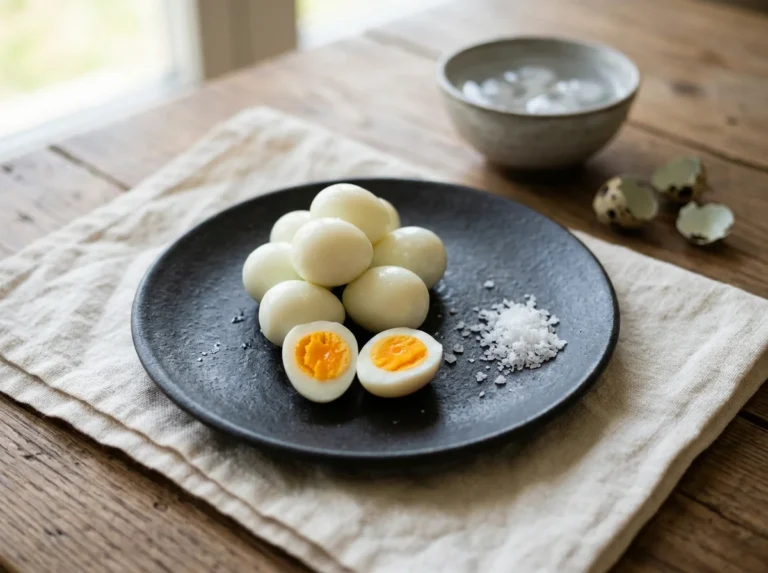
Bring a pot of water to a rolling boil, gently lower in the eggs, and boil for 2 to 5 minutes depending on how firm you want the yolk, then immediately transfer the eggs to ice water to stop the cooking and make peeling easier. Some cooks add a splash of vinegar or a pinch of baking soda to the boiling water, a practitioner tip aimed at making peeling slightly easier, though the effect is modest compared to simply using an ice-water shock; either way, keep the eggs fully submerged throughout the cook time for even results. A shorter, moderate boil of about 3 to 4 minutes produces a firmer, more traditional hard-boiled texture, after which you cool the eggs, gently roll them on a flat surface to crack shell all over, and peel under running water to work through the stubborn inner membrane. Once peeled, hard-boiled quail eggs keep refrigerated for 3 to 5 days, consistent with the food-safety guidance covered earlier in this guide.
How Do You Crack Raw Quail Eggs for Cooking?
For frying or scrambling, use quail egg scissors or a paring knife to make a small hole at the pointed end of the shell, then widen it gently to let the contents drop cleanly into a bowl or directly into a heated pan. As WebMD notes, this method takes more patience than cracking a chicken egg against a counter edge, since the same sharp-tap technique tends to shatter a quail eggshell into small fragments rather than producing one clean break.
How Do You Pickle Quail Eggs?
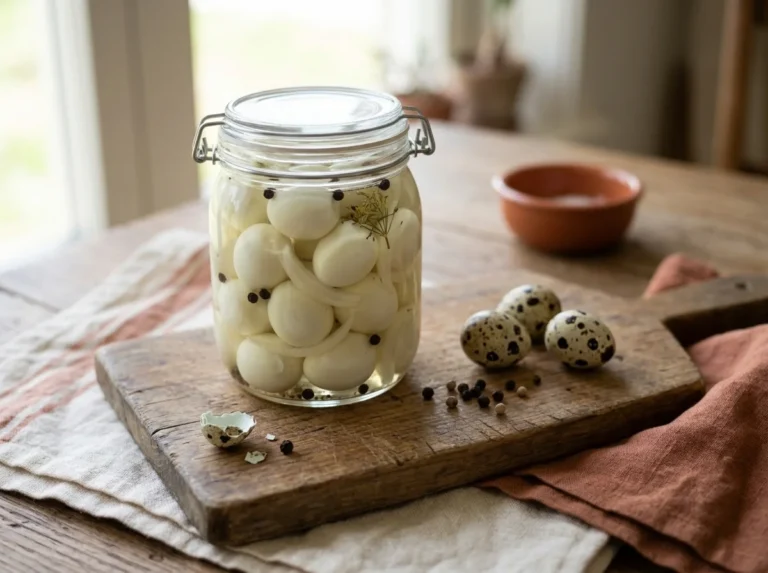
Start by hard-boiling the eggs at a low boil for about 10 minutes, then cool them immediately under cold running water and peel carefully before packing them into a clean glass jar. Make the pickling liquid by combining water, vinegar, salt, chopped onion, and your choice of spices, bringing it to a boil, then optionally straining out the solids before pouring the hot liquid over the peeled eggs in the jar. Refrigerate for at least 48 hours to let the flavor fully penetrate before eating, and keep the jar refrigerated continuously afterward, since pickled quail eggs left unrefrigerated will spoil quickly despite the vinegar’s preservative effect.
Frequently Asked Questions- Quail Eggs, Nutrition, Safety & Cooking
How many quail eggs equal one chicken egg?
Roughly three quail eggs equal one chicken egg by volume, a substitution ratio that works well across most recipes even though cooking time doesn’t scale in exactly the same proportion, as WebMD notes in its own conversion guidance.
Are quail eggs healthier than chicken eggs?
Not definitively — quail eggs carry more cholesterol and fat per gram thanks to their proportionally larger yolk, but they also edge ahead on riboflavin and vitamin B12 per gram, while chicken eggs offer more total protein per serving-size; WebMD, Delve, and Healthline all frame the real-world nutritional gap between the two as small enough that neither is clearly superior overall.
Are quail eggs safe for people with egg allergies?
Generally no — the proteins in quail and chicken eggs are similar enough that cross-reactivity is common, with roughly 70% of children allergic to hen’s eggs also reacting to quail eggs on skin testing, so Delve, Healthline, and WebMD all recommend consulting an allergist rather than assuming quail eggs are a safe substitute for an existing egg allergy.
Can pregnant women or immunocompromised people eat quail eggs?
Yes, as long as the eggs are fully cooked — unpasteurized, raw yolk, or runny yolk preparations should be avoided due to the risk of bacterial contamination, specifically Salmonella, which WebMD, Healthline, and Delve all flag as a real concern for pregnant individuals and people with weakened immune systems.
Do quail eggs carry a food safety risk?
Yes, primarily Salmonella risk if the eggs are undercooked, which is why prompt refrigeration, consistent hand-washing, and cooking to a firm white and firm yolk remain the core precautions Delve and FDA guidance both emphasize.
Where can you buy quail eggs?
Quail eggs are most commonly available at grocery stores (especially Asian grocery stores), natural food stores, farmers markets, and online retailers, sold either fresh, jarred, or canned, as WebMD outlines in its sourcing guidance.
Why are quail eggs more expensive than chicken eggs?
Quail eggs cost more mainly because they’re harder to find, their small size means more eggs are needed per unit of usable protein volume, and the added collection labor drives up cost — a combination WebMD and Healthline both point to as the reason quail eggs have retained a luxury item reputation.
How do you cook quail eggs without overcooking them?
Watch the clock closely rather than judging small size by eye — whether frying, soft-boiling, or baking, quail eggs finish in a fraction of the timing a chicken yolk needs, a point WebMD, Delve, and Healthline all stress for anyone adapting a chicken-egg recipe.
Does dietary cholesterol in quail or chicken eggs harm heart health?
For most healthy people, no — dietary cholesterol from eggs has a smaller effect on blood cholesterol and cardiovascular risk than once believed, and the BMJ 2020 meta-analysis along with Harvard Health 2023 commentary both support moderate egg consumption as part of a heart-healthy diet, a conclusion the American Egg Board also cites in its own guidance.
Raise Quails
Practical, question-first guides for raising healthy, productive quail —from first egg to full coop.
© 2026 Homestead Quail. All rights reserved.