
COOP DESIGN & AVIARY SETUP
Optimal Quail Housing: Safe, Functional & Scalable
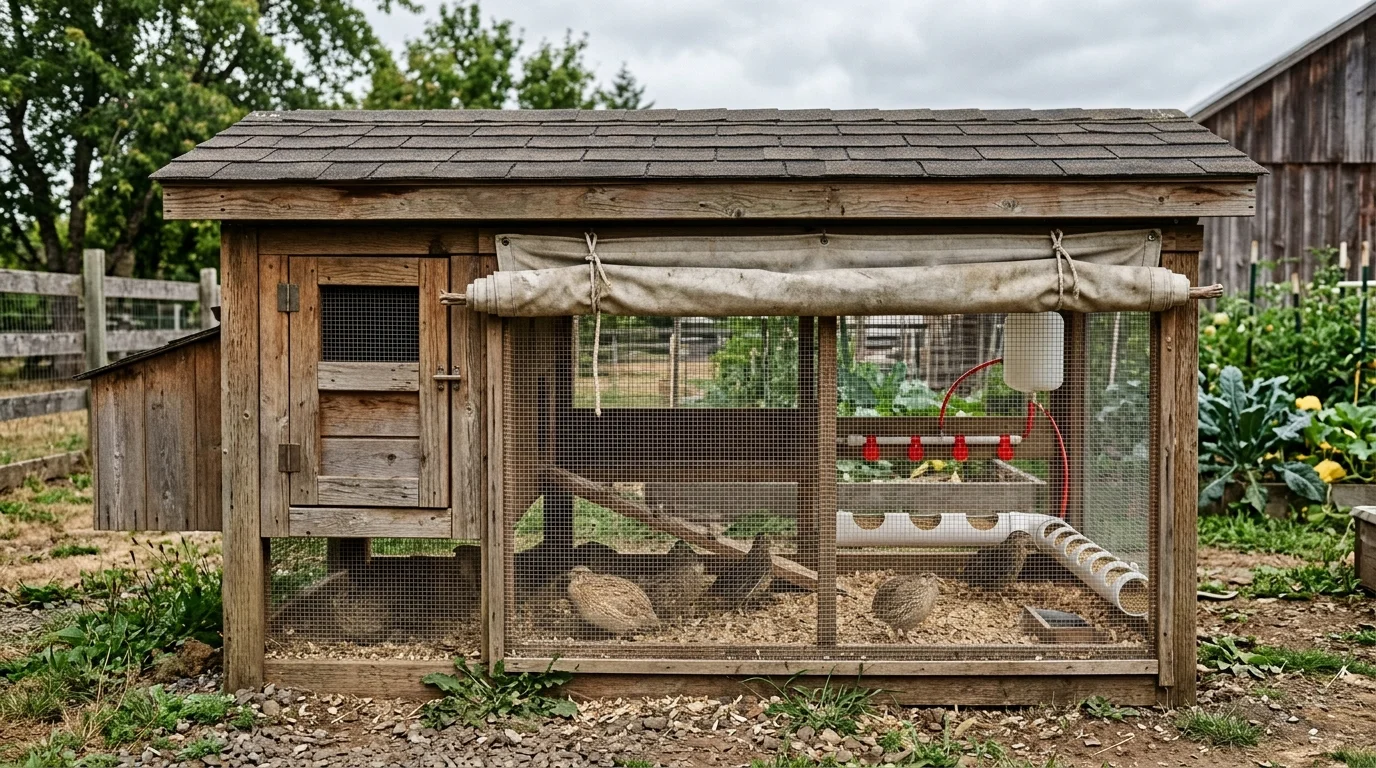
Step-by-step guidance on choosing, building, and maintaining quail hutches, battery cages, ground aviaries, and predator-proof enclosures.
1 Sq Ft
Minimum Space/Bird
1/2 Inch
Mesh wire
10-12 Inchs
Ideal Cage Height
100%
Predator Proofing
What Does Optimal Quail Housing Actually Require?
Optimal quail housing comes down to four non-negotiables: enough floor space per bird, a low or padded ceiling that prevents flush-reflex injuries, flooring that clears waste before it turns hazardous, and construction tight enough to keep every predator out. Everything past that — cage versus pen, wire versus bedding, DIY versus store-bought — is a matter of budget, climate, and how many birds you’re planning to keep.
Coturnix quail, also called Japanese quail (Coturnix japonica), are the species almost all of this guide addresses, because they’re the bird 90%+ of backyard and small-scale keepers raise for eggs and meat. Housing scales from a small starter group in a suburban backyard up to a 500-bird production barn, and the underlying math barely changes — you’re still solving for the same square-footage-per-bird ratio, the same waste-drop-through requirement, and the same need for safe airflow without a direct draft. What changes is the hardware: a hobbyist might stack two rabbit hutches, while a small hatchery runs racks of wire cages over catch pans.
Most housing failures aren’t about the coop’s shape — they’re about skipped fundamentals. Damp bedding left too long breeds ammonia and respiratory disease. Gaps at ground level invite rodents, which in turn attract snakes. A ceiling that’s too tall lets a startled bird build up speed before it hits something. None of these are exotic problems, and none require expensive fixes — they require predator protection, a manageable cleaning routine, and floor space that was calculated correctly on day one. The good news for anyone starting out is that quail are a genuinely low-space, low-effort beginner bird compared to chickens: a coop with an attached run, a hutch, or a stacked cage bank all work, provided you follow the sizing and safety rules in the sections below. Chicks raised in a brooder typically move into permanent adult housing around four weeks old, once they’re feathered out enough to handle ambient temperatures, which is the point where most of these housing decisions actually get put to the test.
What Types of Quail Housing Are Available? Cages, Coops, Pens & Tractors Compared
The main housing styles for quail are wire cages, walk-in coops or pens, mobile tractors, and hutch-style enclosures — and the right one depends on your available space, your goals (eggs, meat, or breeding), and how much daily maintenance you want to take on. Cages suit anyone optimizing for easy cleaning and high stocking density in a small footprint. Walk-in pens and coops suit anyone who wants birds with more room to move and doesn’t mind a larger structure. Tractors suit keepers who want quail on fresh ground without permanent construction, and hutches suit budget-conscious beginners who want a simple, enclosed starter setup.
What Type of Cage or Coop Is Best for Quail?
There’s no single best design — the right choice depends on whether you’re optimizing for space efficiency, ease of cleaning, or bird welfare on pasture, and most experienced keepers end up choosing based on flock size and available yard space rather than any one “ideal” blueprint. A stacked-cage system wins on floor-space efficiency and cleaning speed, which is why it dominates quail coop and best quail coop design searches from people scaling up production. A predator-proof coop with an attached run wins on bird welfare and natural behavior, since the birds get more room to dust-bathe and forage. An A-frame coop is a popular middle ground — cheap to build, naturally shedding rain and snow, and easy to convert into a starter setup for someone with fewer than twenty birds. Coturnix quail enclosures built as a colony cage — one large enclosure housing a mixed-sex group rather than individual breeding pairs — tend to suit egg producers who don’t need pedigreed pairings. Whichever route you take, the goal of a scalable layout is the same: you should be able to add a second unit without redesigning the first.
How Do Cage and Stacked-Cage Systems Work for Quail?
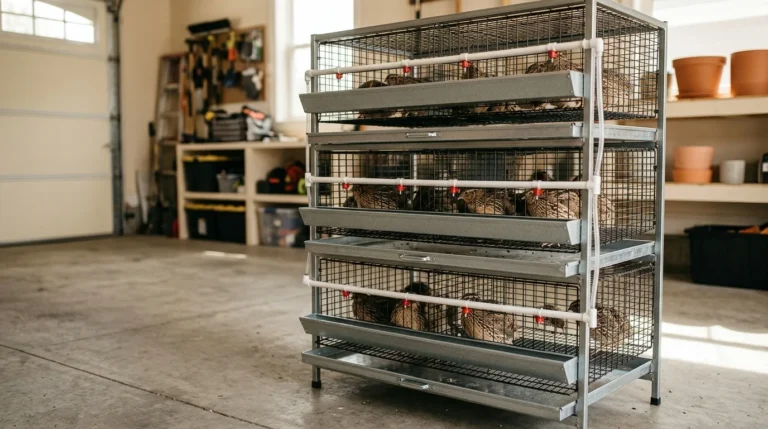
A coturnix quail cage is typically a wire enclosure sized by a simple floor-area formula — divide your total bird count by the target stocking density (commonly 2 to 3 birds per square foot) to get the minimum floor area you need, then choose quail cage dimensions that meet or exceed it. A single tier commonly measures somewhere in the 2-by-2-foot to 2-by-3-foot range, though quail cage size varies widely by manufacturer and DIY design. For example, a cage holding 12 birds at 3 birds per square foot needs at least 4 square feet of floor, while the same 12 birds housed at the more generous 2-per-square-foot density recommended for jumbo Coturnix need 6 square feet.
Stacking quail cages into a vertical rack is the standard commercial-style solution for anyone trying to fit more birds into a smaller building footprint, and it’s also common in indoor quail cages kept in a garage, shed, or basement. Cage floors and sides use coated wire rather than bare welded wire mesh, because uncoated wire corrodes faster and is harder on birds’ feet; the mesh itself should run about ½-inch by ½-inch to keep droppings falling through without trapping toes. Some DIY builders substitute a lightweight PVC-frame cage for the wire-and-wood standard, which cuts weight and cost but requires extra bracing to stay rigid under a multi-tier configuration.
What Are Coops, Walk-In Pens, Fly Pens & Flight Pens?
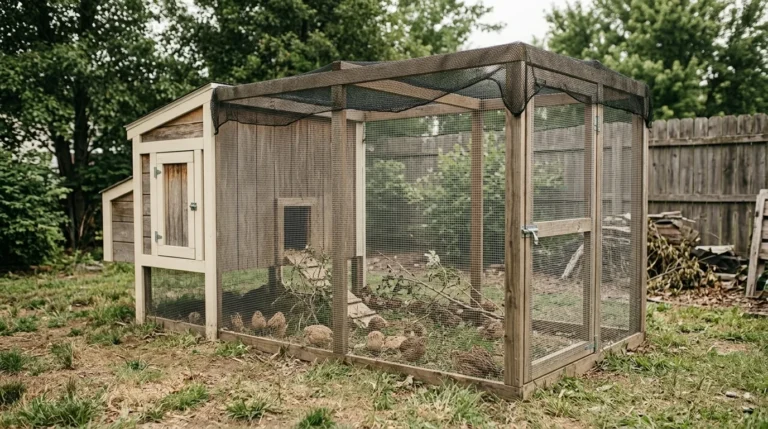
Coops, walk-in pens, and flight pens are all larger, human-accessible enclosures that trade the cage’s compact footprint for more room per bird and easier hands-on management. A quail coop in the walk-in sense — sometimes marketed as a walk in quail coop or coturnix quail coop — typically combines a small enclosed shelter with an attached outdoor run, giving birds a dry retreat plus daylight access. A quail fly pen or flight pen for quail is usually a taller, fully netted structure meant to let birds get a short burst of flight without escaping or colliding with a hard ceiling; these overlap heavily with coturnix quail pens built for breeding groups.
Quail breeding pens are generally ground-level walk-in setups with a netting ceiling rather than a solid one, since breeders need to observe pairings and collect eggs without disturbing the birds constantly. A call back pen for quail — borrowed from gamebird release management, where birds are trained to return to a home pen for feed — is a specialized variant rarely used by backyard Coturnix keepers but common among wild or game quail rearing operations. An elevated quail coop, raised on legs above ground level, adds a layer of rodent and moisture protection and is a popular retrofit for anyone converting an old rabbit hutch or chicken tractor into quail housing.
What Is a Quail Tractor and How Does Mobile Housing Work?
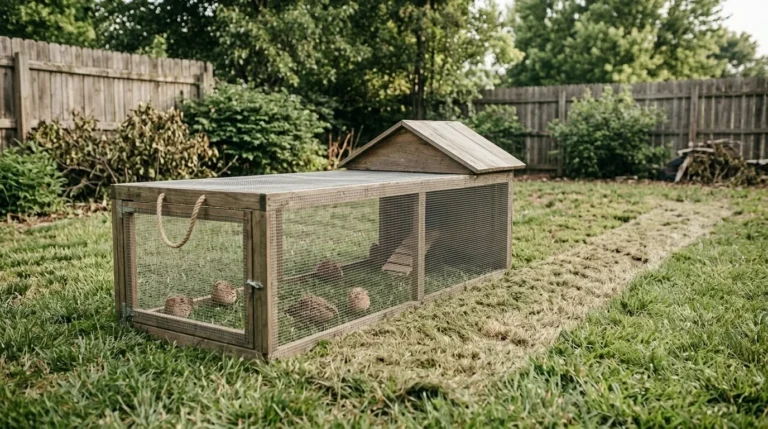
A quail tractor is a roofed, floorless (or wire-floored) mobile pen that you physically move across the ground every one to three days, giving the birds fresh grass and insects while keeping the manure load from concentrating in one spot. Because the birds are in direct contact with bare ground, drainage matters more here than in any other housing style — a tractor left too long on waterlogged soil turns into a mud pit fast. Stocking density in a quail tractor runs lower than in a stacked cage, typically ¾ to 1 square foot per bird, and most keepers house birds in coveys of 8 to 15 rather than large flocks, since a tractor’s manageable weight for daily moving caps how large it can practically get.
Quail tractors work best in mild climates with consistent lawn or pasture access; they’re less practical anywhere the ground freezes solid or floods seasonally, since you lose the ability to relocate the pen. A lightweight frame construction — thin lumber or PVC over hardware cloth — keeps the unit light enough for one person to drag or lift daily, which is the deciding factor in whether a tractor gets used consistently or abandoned after a few weeks.
How Do You Build Homemade or Hutch-Style Quail Housing?
The most common homemade quail cage is a rabbit-hutch-style build: a roughly 4-foot by 1.5-foot footprint with a solid roof and floor on three sides and a wire front, which keeps the interior dry while still giving the birds ventilation and light. A coturnix quail hutch built this way doubles as both housing and a nesting corner, since the solid back and sides give birds the enclosed feeling they instinctively look for when they’re about to lay. This is the design most beginners land on for their first attempt, largely because it can be built from a repurposed rabbit hutch or from budget materials already sitting in a garage.
DIY quail housing at this scale is genuinely easy to keep clean, since the solid floor takes a removable bedding tray or a pull-out droppings board rather than requiring you to service wire underneath. The wire front should still use ½-inch mesh at minimum to keep predators out, and the overall design works best as an easy-to-interact setup — low enough that you can reach every corner for feeding, watering, and egg collection without needing to enter the enclosure itself.
How Much Space Do Quail Need? Stocking Density Requirements Explained
Quail need a minimum of about 1 square foot of floor space per bird in ground pens and hutches, and roughly ⅓ to ½ square foot per bird (2 to 3 birds per square foot) in stacked wire cages, with the exact number depending on housing style, bird size, and whether you’re raising for eggs or breeding. There’s no single universal figure, because a bird given 1 square foot on solid ground behaves very differently than the same bird in an elevated wire cage with a manure tray underneath — density tolerance is tied directly to how fast waste clears and how much territorial behavior the space allows.
How Much Room Do Quail Need in a Cage, and How Much Space Does a Quail Need Per Bird?
As a quick answer: budget 2 to 3 birds per square foot for standard coturnix quail cage setups, 1 to 1.5 square feet per bird for ground pens and aviaries, and ¾ to 1 square foot per bird for mobile tractors. This species-specific space requirement is tighter than most poultry because Coturnix tolerate higher density than chickens do, provided ventilation and cleaning keep pace — but it’s still not a number to round down, since undersizing is the single most common mistake behind how much space do quail need turning from a planning question into a real welfare problem. The reason how much space does a quail need has no single answer is that the figure shifts with housing type and bird strain: a jumbo bird in a ground pen and a standard hen in a stacked cage genuinely don’t need the same footprint. A rough stocking density calculator is simple to build yourself: take your bird count, divide by the density figure for your housing type, and that’s your minimum floor area in square feet.
What Are the Density Benchmarks for Caged or Stacked-Cage Quail?
Standard Coturnix are typically housed at about 3 birds per square foot in stacked cages, while jumbo Coturnix — the larger meat-strain birds — need closer to 2 birds per square foot because of their bigger frame. Working the sizing formula out: 6 birds need at least 2 square feet, 12 birds need 4 square feet, 18 birds need 6 square feet, and 24 birds need 8 square feet at standard density; drop those same bird counts to the jumbo-strain ratio and the space requirement roughly doubles. Pushing much past these numbers into genuinely high density accelerates manure handling demands fast — ammonia buildup between cage tiers becomes noticeable within a day or two if cleaning slips, which is one of the main arguments for the deep litter method never being used underneath wire cages the way it sometimes is in coops.
What Are the Density Benchmarks for Ground Pens, Aviaries & Hutches?
Ground pens, aviaries, and hutches need roughly 1 to 1.5 square feet per bird, with the wider end of that range reserved for mixed-sex breeding groups where territorial behavior is more likely. Oversized ground pens sound like a welfare upgrade, but in practice they can backfire: dominant birds establish territory across the extra space and start “scalping” — pulling feathers from subordinate birds’ heads — which is a behavior overcrowding gets blamed for but under-structured space can trigger too. The 1 sq ft/bird rule of thumb holds up well for a standard 4-foot by 1.5-foot hutch housing a small breeding-group size, but colony housing with a dozen or more birds benefits from being sized closer to the 1.5-square-foot end to reduce chasing and aggression.
What Are the Density Benchmarks for Quail Tractors?
Quail tractors run on the leanest density benchmark of any housing style, at roughly ¾ to 1 square foot per bird, because the mobile nature of the structure limits how large a covey it can practically support. Coveys of 8 to 15 birds are the sweet spot for tractor spacing — large enough to be worth the daily-move effort, small enough that the unit stays light. Once covey size climbs past that range, the tractor’s larger-group mobility limits start working against you: a bigger pen means a heavier pen, and a heavier pen means moves get skipped, which defeats the entire point of tractor housing.
How Does Group Size & Behavior Affect Cage Sizing?
Group size interacts with floor space in ways raw square footage doesn’t capture — feeder and waterer crowding, not total area, is often the first sign a group is too large for its housing. Adding a second feeding or watering station, or splitting a crowded group into two smaller sections, usually solves bullying faster than simply enlarging the pen. Coturnix generally show higher density tolerance than chickens do, but mixed-sex groups still carry territorial risk, which is why the standard breeding ratio runs 4 to 5 females per male rather than housing multiple males together — competing males in the same enclosure escalate aggression quickly once sexual maturity spacing kicks in around six to eight weeks of age. Chronic overcrowding also has a measurable physiological cost: elevated corticosterone, the primary stress hormone in birds, has been linked in poultry research to suppressed egg production and immune function, which is the biological reason density limits aren’t just a comfort preference.
How Tall Should a Quail Enclosure Be? Preventing Flush-Reflex Injuries
A quail enclosure’s ceiling should be no taller than 10 to 12 inches for cages, hutches, and tractors, or at least 6 feet for walk-in pens and aviaries — anything in between is the danger zone, because it gives a startled bird just enough vertical room to build speed before hitting the ceiling. This single design detail causes more preventable quail deaths than almost any other housing mistake, and it’s rooted in basic Coturnix instinct rather than poor luck.
What Is the Ideal Low-Ceiling Height for Cages, Hutches & Tractors?
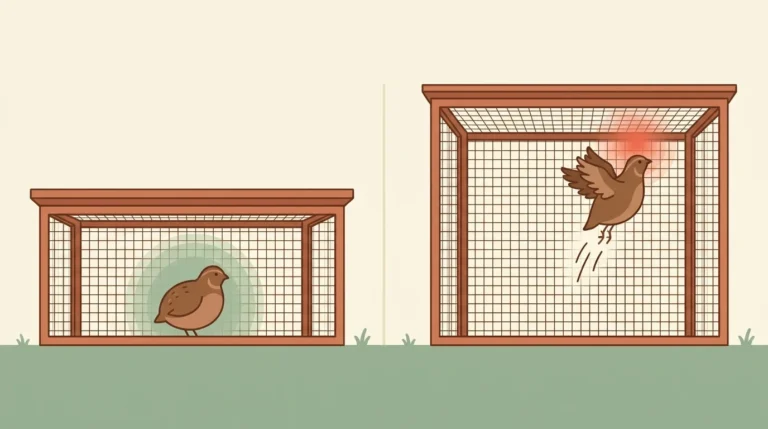
The ideal interior height for cages, hutches, and tractors is 10 to 12 inches, with some keepers capping stacked cage tiers as low as 8 to 12 inches between shelves and hutches running up to about 1.5 feet. This isn’t about cramping the birds — it’s a direct response to the startle/flush reflex: Coturnix, like most quail, respond to sudden noise or movement with a vertical flight instinct that launches them straight up rather than sideways, which is a survival trait against ground predators in the wild but becomes a serious hazard under a hard ceiling. A ceiling capped at roughly one foot physically prevents the bird from reaching a dangerous velocity before contact, cutting the risk of neck injury or a fatal knock-out down close to zero. Any smooth overhead surface should stay free of sharp edges or exposed wire ends, since even a low-speed impact against something rigid can cause harm.
How Tall Should Aviaries and Pens Be, and What Netting Works Best?
Walk-in pens and aviaries need to go the opposite direction — ceilings of at least 6 feet, and ideally 6 to 7 feet or more, so there’s enough clearance that a flushing bird loses momentum before it ever reaches the top. Soft or padded netting is the standard covering for this height range rather than solid roofing, both because it’s cheaper across a larger span and because netting gives slightly on impact instead of stopping a bird cold. Some builders add a false netting ceiling as a backstop a foot or two below the true roofline — this low-profile housing alternative catches any bird that does flush hard, cushioning the impact well before it reaches the rigid structure above. If you’re not confident you can commit to true 6-foot-plus clearance, it’s safer to build shorter and stick to the sub-12-inch cage standard than to land in the mid-range height that causes the most injuries.
What Type of Flooring Is Best for Quail? Wire, Plastic, Bedding & Solid Floors Compared
The best flooring for quail depends on your priority: wire or textured plastic flooring wins on hygiene and hands-off cleaning, while bedding over a solid floor wins on comfort and natural behavior like dust bathing. There’s a genuine trade-off between the two, and most experienced keepers pick one based on how much daily cleaning time they’re willing to spend versus how much they want to see birds foraging and dust bathing.
What Type of Flooring Is Best for a Quail Cage?
For a caged setup specifically, correctly sized wire or bedding for quail are both workable, but wire is the more common choice because it drops waste through the floor automatically instead of letting it accumulate underfoot. The comparison really comes down to a hygiene-workload trade-off: wire needs a manure tray you empty regularly but requires no bedding changes, while a solid floor with bedding needs to be topped up and fully replaced periodically but gives birds better traction and a more natural surface to stand on. Correctly sized grid spacing matters regardless of which you choose, since anything too open becomes an anti-slip flooring hazard for tiny feet, and anything too tight stops waste from passing through.
How Tall Should Aviaries and Pens Be, and What Netting Works Best?
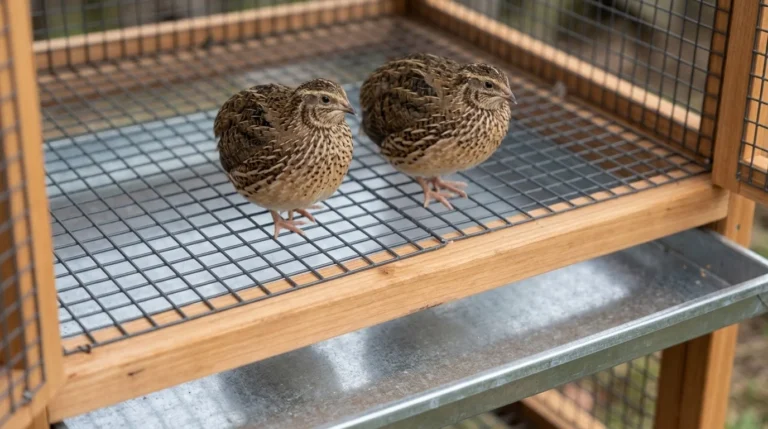
Wire or suspended mesh flooring works by letting droppings fall through into a manure tray or catch pan below, keeping birds physically separated from their own waste around the clock. Coated wire is preferred over bare metal for exactly this application, and the mesh itself should run about ½ inch by ½ inch or ½ inch by 1 inch — tight enough to prevent toe entrapment, open enough that droppings pass through cleanly rather than building into hardened deposits on the surface. A catch pan or barrier underneath needs to be pulled and cleaned on a “clean-wire-daily” standard in high-density setups, since fecal buildup left in contact with the wire raises parasite pressure and increases the risk of bumblefoot, a painful foot infection that shows up more often on birds standing on wire with too-small pad size relative to their body weight — a bigger concern with jumbo-strain birds than standard Coturnix.
Is Textured Plastic Flooring Good for Quail?
Textured plastic flooring is a solid middle-ground option, giving birds less-slick footing than smooth wire while still allowing waste drop-through when the grid is correctly sized. It functions as a rubber matting alternative for keepers who want better traction than bare wire without taking on the full cleaning workload of loose bedding, and it holds up well in stacked-cage systems where you still need waste to fall clear of the birds’ feet.
How Do Bedding and Solid-Floor Systems Work for Quail?
Bedding and solid-floor systems replace wire entirely with a solid base — often sand, soil, or a wood-based litter — that birds can dust bathe and forage in, which wire flooring can’t offer at all. This comes at a real hygiene-workload cost: damp bedding left too long produces an ammonia odor and creates a respiratory stress risk that’s more acute than anything associated with a properly maintained wire-and-tray system. Pine shavings, grass hay, and straw are all commonly used bases, but cedar shavings should never be used — the aromatic oils they release are toxic to quail’s respiratory systems, a mistake that shows up surprisingly often among first-time keepers who assume any wood shaving is interchangeable. Deep bedding piled over a wire or wood base can trap moisture against the structure underneath, encouraging wet-wood bacteria and parasites, so ammonia-free bedding options need to be paired with a cleaning schedule tight enough to catch dampness before it sets in — not treated as a set-and-forget system.
What Foot-Health Signs Should You Watch For on Quail Flooring?
The clearest sign your flooring needs attention is a bird
favoring a foot, showing slipping or unstable footing, or resting more than
usual on one leg — all of which point to poor traction or early foot irritation
before it turns into something worse. Better-traction flooring or a small
resting mat placed in one corner solves mild cases, while tray-spacing
adjustments help when the manure catch is close enough to the wire to cause
repeated contact. Building a simple pad-health inspection routine into your regular
cleaning — checking for swelling, discoloration, or mites while you’re already
handling the tray — catches most flooring-related problems well before they
become a genuine skin condition requiring treatment.
How Should You Ventilate a Quail Coop or Cage?
Quail housing needs steady airflow through wire sides or vents without any direct draft hitting the birds, because Coturnix are genuinely cold-hardy but noticeably draft-sensitive — the two are not the same thing. Getting this balance wrong in either direction causes problems: too little airflow lets humidity and ammonia odor build up between cage tiers, while too much direct airflow from doors, windows, fans, or AC vents stresses birds even in mild weather.
Cross-ventilation design — airflow that moves horizontally through the structure rather than pooling in corners — is the standard approach for coops and stacked systems, and it works alongside passive ventilation features like gable vents or gapped siding that don’t rely on powered fans. The goal is a healthy air-exchange rate that clears stale air continuously; if you ever notice an ammonia smell inside the coop, treat it as a warning sign that ventilation isn’t keeping pace with waste output, not as something to mask with more bedding. In winter, vents should sit above bird height rather than at floor level, since a floor-level vent in cold weather creates exactly the kind of direct draft that stresses birds, while a high vent still exchanges air without chilling anyone directly. Good ventilation is also your first line of mold prevention in any bedding-based system, since trapped humidity is what lets mold take hold in damp corners.
How Do You Manage Quail Manure and Cleaning Routines?
Manure management for quail comes down to a repeatable tray workflow — pull, scrape, sanitize, reinsert — run on a predictable cadence rather than an as-needed basis, since waiting until bedding smells bad means you’ve already fallen behind. Manure trays in cage systems should be checked every few days at minimum, with the exact frequency scaling up based on bird count and ambient humidity; a hot, humid week demands more frequent checks than a cool, dry one. Spot-cleaning wet bedding the moment you notice it — rather than waiting for a full changeout — is the single most effective habit for keeping ammonia from building up between full cleanings, and an ammonia-like or sour bedding smell is your clearest signal that a spot-clean is overdue. Hutch bedding on a solid floor generally needs a full clean one to two times per week, using a simple scoop-and-dustpan method that takes only a few minutes once it’s part of your routine.
Manure that piles up unmanaged does more than smell bad — it directly links to bumblefoot risk from birds standing in wet mess, and droppings piling up outdoors attracts both predators and flies, compounding two problems at once. If you keep an outdoor run or ground pen, roof cleaning quail run maintenance matters too: a tarp or corrugated roofing panel over an outdoor enclosure needs periodic clearing of leaves and debris so rainwater doesn’t pool and drip straight onto bedding below. Collected manure doesn’t have to be a waste product — composting quail manure is a common way small-scale keepers turn cleanout waste into garden fertilizer, provided it’s composted long enough to break down safely. Building all of this into a consistent biosecurity routine — clean tools, controlled foot traffic between coops if you run multiple flocks, and prompt waste removal — reduces disease pressure across the whole setup, not just odor.
How Do You Predator-Proof Quail Housing?
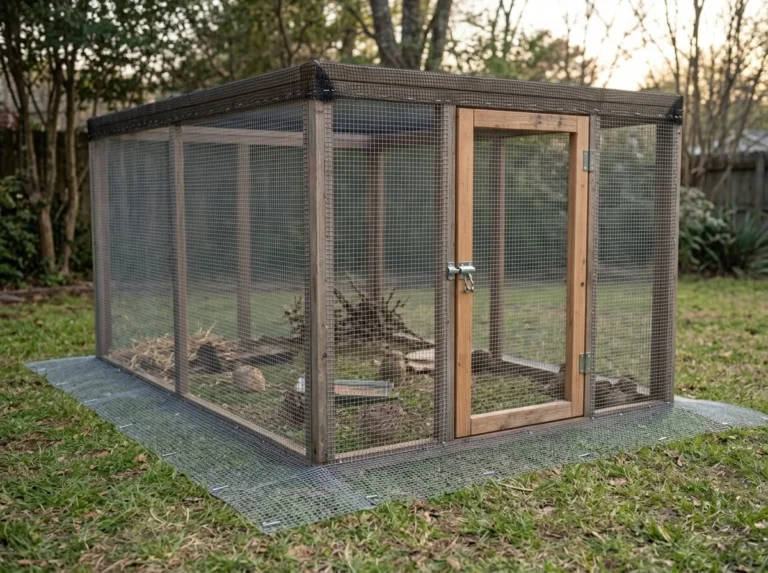
Predator-proofing quail housing means using hardware cloth rated ¼ inch to ½ inch rather than standard chicken wire, since chicken wire’s larger gaps let raccoons reach through and smaller predators squeeze in entirely. Chicken wire is genuinely too chewable, tearable, and penetrable to trust around quail-sized prey, and it’s one of the most common corners cut by beginners who assume any wire mesh offers equal protection.
Every seam and edge needs to be buried or tightly sealed, because a raccoon-proof design isn’t just about the mesh size — it’s about eliminating gaps a determined animal can pry open or dig under. A dig-proof skirting, where hardware cloth extends outward or downward along the base of the structure, stops burrowing predators from tunneling in beneath the walls. Overhead protection matters just as much: hawks and owls present a real talon risk to any uncovered run, which is why aerial-predator netting across the top of outdoor pens is standard practice, not an optional extra. A wire-bottomed catch pan under caged setups adds another layer of protection by keeping ground predators from reaching birds through the floor itself. Feeders should be secured and feed storage kept sealed, since spilled feed and manure smell are both major predator attractants that draw animals toward the coop in the first place; some keepers add motion-sensor lighting around outdoor enclosures as a low-cost deterrent for nocturnal predators. This is also the core reason quail should never be free-ranged — a released bird that startles and flees is extremely vulnerable in the open, with a low rate of return even when the enclosure is left open intentionally.
What Is the Best Water System for Quail Housing?
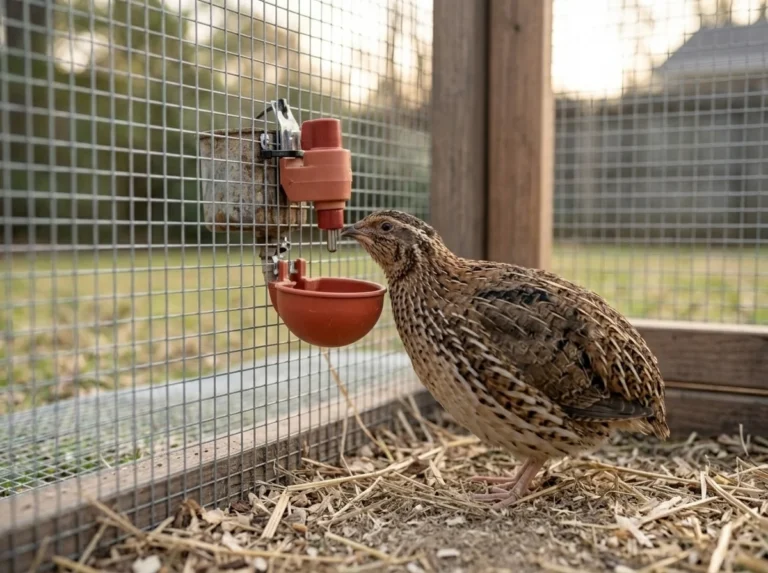
The best water system for quail housing is an elevated nipple-style drinker, because open bowls foul quickly with bedding and droppings and create tracked moisture that undermines everything else you’re doing to control humidity and ammonia. Nipple waterers with attached dribble cups solve the mess problem directly — birds peck the nipple to release water into the small cup below rather than wading through or spilling an open container — and they’re mounted at chest height so birds drink without climbing into the water source.
Standard poultry quart founts or chick waterers still work fine for smaller setups or brooders, but they need daily changing at minimum, since standing water in an open container fouls fast regardless of design. An automatic waterer system, whether gravity-fed or connected to a small reservoir, cuts daily labor significantly for larger flocks and is worth the upfront cost once you’re managing more than a couple dozen birds. Whichever system you run, a weekly bleach-solution scrub keeps biofilm and algae prevention in check, since nipple lines and reservoirs both grow algae readily in warm weather if left un-scrubbed. In freezing climates, heated rabbit-style bottles prevent ice buildup automatically, while keepers without heated equipment typically manage with a twice-daily ice-and-fresh-water swap through the coldest stretches of winter.
How Do You Winterize Quail Housing for Cold Weather?
Winterizing quail housing means blocking wind and moisture rather than chasing warmth, because Coturnix tolerate cold far better than most keepers expect as long as the enclosure stays dry and out of direct wind. The instinct to over-heat a winter coop is understandable but usually counterproductive — trapped humidity from an overheated, poorly ventilated space causes more health problems than the cold itself does.
Do Quail Need a Heat Lamp in Winter?
Adult quail generally don’t need a heat lamp in winter, provided their housing is sheltered from wind and moisture — heat lamp necessity really comes down to climate severity and whether you’re housing adults or brooder-age chicks, since young birds without feathers can’t regulate their own temperature yet. Anyone asking how long do quails need a heat lamp is usually raising chicks: brooder-age birds need supplemental heat until they’re fully feathered around four to five weeks old, after which most adult Coturnix handle ordinary outdoor winter temperatures without any added heat. If you do run a heat lamp for quail through a severe cold snap, mount it well clear of bedding and aim it at one end of the enclosure so birds can move away from the heat rather than being forced to sit under it. A ceramic heat emitter alternative to a traditional bulb is worth considering wherever supplemental heat genuinely is needed, since it produces warmth without the bright light that can disrupt egg-laying cycles or roosting patterns. Whatever heat source you choose, a heat-lamp fire-safety caution applies every time — heat lamps are a leading cause of coop fires, and a securely mounted, properly rated fixture is not optional in bedding-heavy housing.
Can Quails Survive Winter Outdoors?
Yes — Coturnix quail can survive winter outdoors, including sub-zero temperatures, as long as they have shelter from wind and moisture, since cold-hardy birds regulate body heat effectively when they’re dry and out of a direct draft. Wind and wet conditions are the real danger here, not cold air on its own: a wet bird in a 20-degree wind loses body heat far faster than a dry bird sitting in single-digit stillness. So when keepers ask can quails survive winter in an unheated backyard coop, the honest answer is that most can, and the variable that decides it is shelter quality rather than the thermometer. The practical answer to how to keep quail warm in winter is almost entirely structural: three-sided wind protection — solid walls on the sides facing prevailing weather, open only where wind exposure is minimal — combined with thick straw the birds can burrow into covers most no-supplemental-heat cases without issue. Frostbite prevention mainly comes down to keeping housing dry rather than adding heat, since damp feathers and skin are what actually freeze, not cold-but-dry conditions.
How Do You Winterize a Coop, Pen or Hutch?
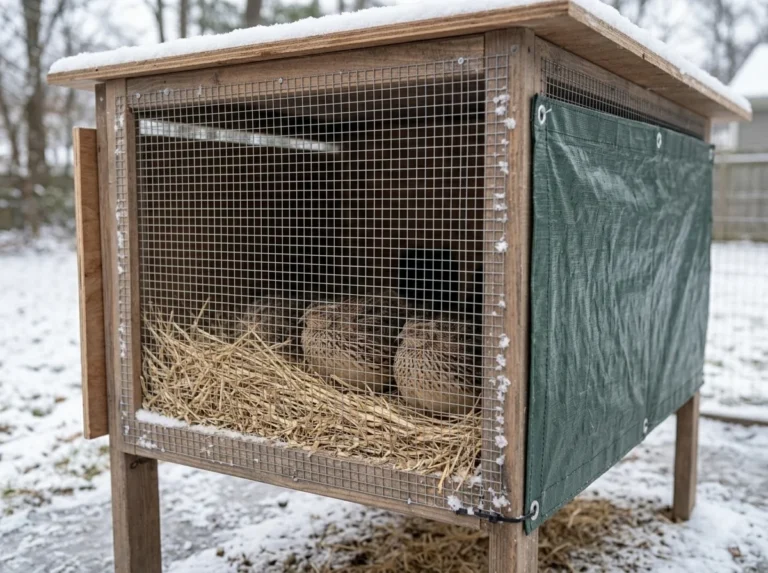
Winterizing existing housing starts with tarping exposed cage sides to block wind while leaving a small air-escape gap so moisture and frost don’t accumulate inside the covered space. Adding bedding directly over wire flooring in freezing conditions gives birds an insulated surface to stand on, functioning as deep litter for warmth even in cage setups that normally run bare wire year-round. Ground and aviary housing needs a roofed shelter section or elevated enclosed retreat where birds can get fully out of the wind, and wind-break placement — positioning solid barriers on the prevailing-wind side of the structure — makes a bigger practical difference than any amount of added insulation. Keeping water from freezing is the last major piece, handled either with a heated base or the twice-daily swap routine covered earlier, and an insulated coop panel added to just the wind-facing wall is often enough without insulating the entire structure.
Do Quail Need Nesting Boxes and How Do They Behave in Housing?
Quail don’t need nesting boxes the way chickens do — they’re ground-layers by instinct, and forcing a chicken-style nest box setup on them is unnecessary rather than helpful. Understanding this instinct also explains why quail don’t roost and why they respond so strongly to hiding spots inside their housing.
Do Quail Need Nesting Boxes?
No — quail lay perfectly well without dedicated nesting boxes, and most hens will simply lay wherever they happen to be standing if no bedding or cover is provided at all. That said, giving birds a loose grass-hay nest or something as simple as an overturned bucket or flower pot with an entry cut into it — sometimes called a “mouse hole” setup — noticeably increases how often hens use a consistent spot rather than scattering eggs across the whole floor. This taps directly into a nest-site camouflage instinct: wild quail nest in dense ground cover for concealment from predators, and a dark, enclosed corner mimics that instinct even in a fully controlled enclosure. In practice, quail nesting behavior is less about the container and more about the sense of enclosure — hens consistently choose the darkest, most sheltered corner available. Any loose material used as egg-laying substrate should stay dry and be refreshed regularly, since damp nesting material creates the same ammonia and hygiene issues as damp floor bedding anywhere else in the coop.
Why Don't Quail Roost on Bars Like Chickens?
Quail don’t roost on bars because they’re fundamentally ground-sleeping birds, unlike chickens, which have a strong evolved instinct to perch off the ground at night. Coturnix typically sleep in a loose, tail-to-tail circle directly on the floor or bedding, a ground-nesting behavior carried over from their wild ancestry as birds that nested and slept in dense grass cover rather than trees. Quail roosting in the chicken sense essentially doesn’t exist for Coturnix, which surprises keepers coming from chickens and leads to a lot of unused perches sitting in otherwise well-designed enclosures. This means you can skip roosting bars entirely when designing housing — they serve no function for this species and just take up usable floor space that could otherwise go toward stocking density.
What Do Quails Like in Their Cage?
Quail like branches, brush piles, or any low cover they can duck under, because it gives them a genuine sense of security that an open, empty enclosure doesn’t. This preference connects directly back to their duck-for-cover instinct: when startled, a quail’s first response is to try to get under something rather than fly upward, and only flushes upward as a last resort when no cover is available — which is exactly the startle/flush reflex covered earlier in the height section, and exactly why hiding spots and cover reduce injury risk as much as ceiling height does. An enclosed nesting or sleeping corner serves the same purpose as a branch pile, and skittish breeds in particular benefit from having multiple cover options spread through the enclosure rather than one central hiding spot everyone competes for.
What Feeders, Waterers & Accessories Do Quail Need?
Quail housing needs a front-mounted feed trough, a gravity-fed water system, and ideally a roll-out egg collection feature — the same core accessories that make chicken coops functional, just scaled down to quail size. A front-mounted feed trough keeps feed accessible without birds standing directly in it, and standard poultry quart waterers or small chick feeders work well for smaller flocks even though dedicated quail-sized equipment exists and reduces waste further.
Roll-out egg trays are worth the small extra cost in any production-focused setup, since they let eggs roll gently out of the enclosure onto a padded collection area, meaningfully reducing breakage compared to eggs left sitting on wire or bedding where birds can step on them. Removable middle dividers let a single cage function as two or more breeding sections, useful for anyone managing controlled pairings without building separate structures. A treadle feeder — a feeder with a foot-pedal-activated lid — helps keep feed dry and rodent-free between visits, and a small grit dish should be offered alongside regular feed, since grit supports digestion the same way it does in chickens. Elevated dishes set on saucers and parrot-style clip bowls for oyster shell are both simple additions that cut down on feed and calcium supplement waste getting kicked into bedding. Paying attention to feed conversion ratio — how efficiently birds turn feed into eggs or body weight — is mostly a feed-quality and management question rather than a housing one, but poor housing hygiene and stress both measurably drag feed efficiency down, which is one more reason the fundamentals in this guide matter beyond animal comfort alone.
What Equipment and Supplies Do You Need to Start Farming Quail?
A starter setup for quail farming needs housing, a feeder, a waterer, bedding, and — if you’re raising from chicks — a brooder and heat source, which together make up the core quail supplies checklist for anyone getting started. Beyond the daily-use basics, most keepers also end up needing an incubator and brooder box if they plan to hatch their own eggs, since this is genuinely adjacent equipment rather than optional extra gear once breeding enters the picture. A heat plate is a safer brooder-heat option than a traditional lamp for young chicks, egg cartons make sense the moment production exceeds what your household eats, and a small coop cleaning tool kit — scoop, dustpan, scrub brush, and a dedicated bucket — turns the manure routine covered earlier from a chore into a five-minute habit. None of this quail farming equipment needs to be purchased all at once; most keepers add pieces as their flock and goals grow rather than buying a full setup on day one.
How Do You Size Cages for Breeding Configurations, and What Mistakes Should You Avoid?
Breeding-configuration cage sizing follows the same floor-area math as standard housing, with the main addition being removable dividers that let you split one cage into multiple controlled-pairing sections. Most of the mistakes that show up in breeding setups are the same mistakes that show up everywhere else in quail housing — they just have a bigger impact when egg fertility or hatch rate is on the line.
What Are Standard Stacked-Cage Tier Footprints and Capacities?
A common commercial reference point for stacking quail cages is a base footprint around 38.6 inches by 24 inches, scaled across one to five layers with total height ranging from roughly 23 inches for a single tier up to about 77.2 inches for a full five-tier unit. Each layer in this configuration typically offers around 4.3 square feet of usable floor space, though many manufacturers section that floor into smaller compartments — commonly around 1.42 or 2.86 square feet per section — to separate breeding pairs or small groups within the same tier. This kind of compact starter-scale reference is useful even if you’re building your own rack rather than buying a commercial unit, since it gives you a proven ratio of footprint to bird capacity to design around.
How Do Breeder-Configuration Dividers Work for Controlled Pairings?
Removable middle walls let a single cage function as two separate breeding sections, which is the standard way small-scale breeders manage controlled pairings without doubling their equipment. This setup supports smaller breeding groups housed side by side, and the divider can simply be lifted out afterward to let both sections open into one shared hutch-style space once breeding season ends and birds go back to general flock housing. A basic breeding trio setup — one male with two or three females — fits comfortably in a single divided section sized using the standard ground-pen density figures covered earlier in this guide.
What Are the Most Common Quail Cage Setup Mistakes?
The most common quail cage setup mistakes are overcrowding, excess interior height, wrong mesh spacing, and inconsistent manure management — and nearly every welfare problem in quail housing traces back to one of these four. Overcrowding shows up as visible pushing and chasing around feeders and waterers well before it becomes an obvious space complaint. Excess interior height causes head injuries from the flush reflex covered earlier, and it’s an easy mistake to make when repurposing furniture or structures built for a different animal. Slick floors or wrong mesh spacing lead to foot problems and toe entrapment, while loose manure management lets ammonia and flies build up faster than most keepers expect. A less obvious but serious mistake is mixing button quail in with Coturnix, since the size and housing-need mismatch between the two species causes real harm to the smaller birds. All of these mistakes tend to show up first as a dip in egg output — stressed, injured, or crowded birds lay less consistently, which makes egg production a genuinely useful early-warning signal, not just an income metric. Running through this list as a troubleshooting checklist format whenever production drops unexpectedly catches most of these issues before they become chronic.
Do Different Quail Species Need Different Housing?
Yes — housing requirements differ meaningfully between Coturnix, button quail, and wild or game quail species, and applying Coturnix standards across all three is a common and sometimes harmful mistake. Body size, temperament, and legal status all vary enough that a setup ideal for one species can be genuinely unsuitable for another.
How Does Housing Differ for Coturnix, Button Quail & Wild Quail?
Coturnix-style production cages are designed around a bird several times the size of a button quail and are not appropriate for the smaller species, which need habitat-style, aviary, or ground-level enclosures instead. Button quail (Excalfactoria chinensis), also called Chinese Painted Quail, are typically housed in pairs rather than colony groups, do best at a stable ambient temperature around 70°F within a tolerable 45°F to 85°F range, and need roughly 4 square feet per pair. Their housing specs differ sharply from Coturnix standards: bar or mesh spacing must stay under ½ inch to prevent escape and entrapment, ceiling height should cap around 14 inches, and wire flooring should be avoided entirely because their tiny feet are far more prone to injury on mesh than a full-sized Coturnix foot. Silk plants or similar soft hiding spots work well as cover in button quail enclosures, giving the same security benefit branches provide for larger birds without the bulk.
Wild and game species — including bobwhite, California, Gambel’s, mountain, and blue scale quail — need different housing again, generally larger flight-capable enclosures suited to birds with much stronger flight instincts than domesticated Coturnix. Bobwhite quail housing in particular is usually built as a tall flight pen rather than a cage, since these birds are commonly raised for release or hunting preserve stocking rather than backyard egg production. Before acquiring any wild or game species, check applicable gamebird regulations in your area — many states require permits to possess, breed, or release native quail species, and these requirements are separate from any zoning rules governing backyard poultry generally.
Is a Rabbit Hutch Good Starter Housing for Quail?
A rabbit hutch is arguably the single best starter housing for a small Coturnix flock, and a standard 4-foot by 1.5-foot unit is the go-to recommendation for anyone keeping their first handful of birds. The typical hutch design — enclosed on three sides with a solid roof and floor, and a wire front fitted with a feeding and egg-collection door — hits nearly every quail housing requirement at once: it’s dry, draft-controlled, predator-resistant, and low enough that the flush reflex never becomes dangerous. The enclosed rear section naturally doubles as a nesting area without any additional construction, and the footprint comfortably fits a breeding group of four to five females per male.
Build cost varies considerably depending on whether you assemble from raw materials or buy pre-made. A DIY build from dimensional lumber and hardware cloth generally runs well below the price of a finished commercial hutch, while repurposing an existing rabbit hutch costs close to nothing beyond replacing any wire with correctly sized mesh. For anyone weighing budget housing options against convenience, the practical trade-off is straightforward: a self-built hutch costs less and lets you control mesh size and ceiling height precisely, while a pre-made unit saves a weekend of work but often needs modification anyway to bring the wire spacing down to quail-safe dimensions.
Where Should You Put Quail Housing? Site Planning & Indoor Options
Quail housing should go somewhere accessible in all seasons, protected from standing water, and far enough from neighbors that odor never becomes an issue — and for many keepers, that location ends up being indoors in a garage or shed rather than in the open yard. Site selection gets far less attention than coop design, but a well-built coop in a bad spot creates more ongoing work than a modest coop placed thoughtfully.
How Do You Choose a Site and Plan Pen Placement?
Choose a site that stays accessible in all seasons, drains naturally, and sits close enough to power for supplemental lighting if you plan to maintain winter egg production. Slightly elevated or naturally draining ground is worth seeking out specifically, since standing water and runoff around the base of a coop create year-round dampness that undermines bedding, encourages mold, and attracts pests — and snowmelt or heavy rain pooling under a stacked cage system is a particularly common problem where drainage wasn’t considered during placement. In cold climates, most keepers place housing within roughly 20 to 30 feet of the house, close enough that daily winter chores stay manageable but far enough that odor and noise don’t carry indoors.
Distance from neighbors deserves genuine thought before construction rather than after the first complaint. Quail are quieter than chickens, but manure odor from a poorly maintained setup carries, and a few extra feet of separation costs nothing at the planning stage. Coop orientation relative to prevailing wind direction is the other placement factor worth getting right — positioning the solid walls toward incoming weather and the open or wire side away from it does more for winter comfort than insulation ever will. Finally, check local zoning laws and backyard regulations before building; many municipalities that restrict roosters or limit chicken counts treat quail differently or exempt them entirely, but assuming that without verifying is a costly mistake.
Can You House Quail Indoors in a Garage or Shed?
Yes — quail do well in garages and sheds, and this is one of the most practical options for urban keepers, provided you take indoor airflow seriously. Enclosed spaces let dust and ammonia build up faster than outdoor housing does, simply because there’s no natural air exchange to carry it away, so indoor quail cages in a garage need either cross-ventilation through open windows and vents or a fan positioned to move air through the space without blowing directly on the birds. The upside is meaningful: indoor housing gives you sun-exposure and temperature swing control that outdoor setups can’t match, along with consistent lighting, which matters for maintaining egg production through short winter days when natural daylight falls below the roughly 14 hours hens need to lay reliably. Before committing, consider how noise and daily access fit your household routine — birds in an attached garage are audible indoors, and you’ll be servicing trays in that space several times a week year-round.
Can Quail Free-Range, and How Do You Enrich Their Housing?
Quail should not be free-ranged — unlike chickens, they won’t return to the coop, and their instincts make an enclosed, cover-rich setup a far better fit than open yard access. This makes behavioral enrichment inside the enclosure much more important for quail than for species that get their stimulation from ranging.
Can Quail Free-Range?
No — free-ranging quail is not recommended, because a released bird is very unlikely to return to its housing. Where a chicken has a strong homing instinct and will come back to roost, a quail that finds itself in open space will typically hide under the nearest bush and stay there, meaning free range quail in the backyard-poultry sense essentially means permanently lost birds. Anyone asking can you free range quail is usually hoping to give birds a more natural life, which is a reasonable goal — but the better answer is a larger, well-covered enclosure rather than open access. A realistic flight-risk assessment makes the case plainly: Coturnix retain enough flight capability to clear a fence but not enough navigational instinct to come home, which is the worst possible combination. An enclosed, cozy setup with cover, dust-bathing space, and room to move genuinely suits their instincts better than free ranging quail ever will.
Can You House Quail With Chickens?
No — quail should never be housed with chickens, and can quail free range with chickens is one of the more consequential questions beginners get wrong. The primary risk is disease transmission: chickens commonly carry Mycoplasma and infectious coryza asymptomatically, and both can be severe or fatal in quail, which makes cross-species housing a genuine biosecurity failure rather than just an inconvenience. Dietary needs differ too — quail require significantly higher protein feed than laying hens do, and a shared feeder means one species or the other is being fed incorrectly. On top of that, the sheer size disparity creates an injury risk from ordinary interspecies aggression; a hen doesn’t need to be hostile to seriously hurt a bird a fraction of her weight during a routine squabble over feed.
How Do You Enrich a Quail Enclosure With Branches and Cover?
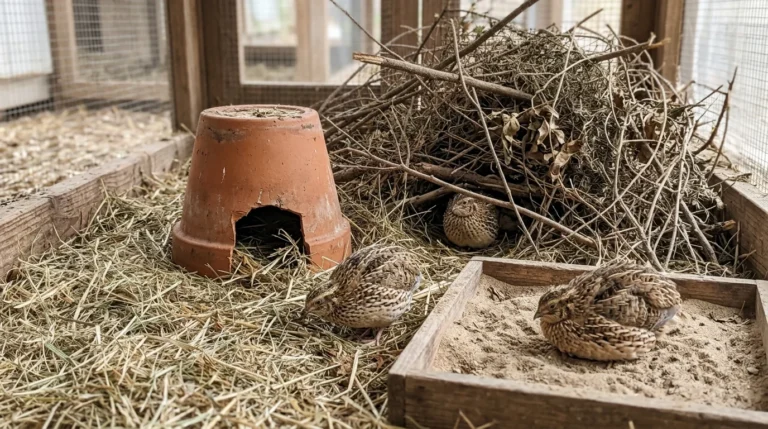
Adding branches, brush piles, or similar low cover to cages, hutches, pens, and aviaries replicates the brush-pile shelter quail seek out in the wild, and it measurably calms skittish birds. The mechanism ties back to instinct: a quail with accessible cover ducks for shelter when startled rather than flushing upward, which directly reduces the neck-injury risk that makes ceiling height such a critical design factor in the first place. This matters most for skittish strains and for birds that haven’t been handled much. Rotating enrichment periodically — swapping in fresh branches, moving a hiding spot to a new corner, adding a shallow dust-bathing tray — keeps birds engaged and is a low-cost habit that pays off in visible behavior changes within days.
How Does Housing Interaction Affect Taming?
Regular, calm interaction at the enclosure dramatically
reduces skittishness, and housing that lets you approach and service birds
without startling them is what makes that interaction possible. Birds handled
consistently from a young age stop flushing when the pen door opens, and many
will start approaching for treats within a few weeks — a change that makes
every housing chore easier and lowers stress-related production dips. Hens that
are genuinely comfortable often purr or coo softly at feeding time, which is
one of the clearest behavioral indicators that a setup is working. Imprinting
and hand-taming are far more effective with chicks handled during their
first weeks than with adults acquired later, so if tameness matters to you, a
housing design with easy front access is worth prioritizing from the start.
How Do You Set Up Quail Housing Step by Step?
Setting up quail housing follows a reliable order: choose a housing style, prepare the site, calculate floor space, set interior height, install flooring, predator-proof the structure, plan ventilation, add water and feed systems, establish a cleaning cadence, and prepare for cold weather before birds ever arrive. Following this sequence matters because several of these decisions constrain the ones after them — you can’t sensibly choose flooring before you’ve picked a housing style, and you can’t size a structure before you know your bird count and density target.
- Choose a housing style based on your goals and available space — cage, ground pen or aviary, hutch, or tractor.
- Select and prepare the site: season-accessible, well-drained, near power, and odour-conscious relative to neighbours.
- Calculate required floor space using the density benchmark for your chosen housing type.
- Set interior height per housing type to prevent flush-reflex injury.
- Choose and install flooring — wire or textured plastic over a manure tray, or bedding over a solid floor.
- Build in predator-proofing from day one with hardware cloth, buried edges, and catch pans.
- Plan steady ventilation that never becomes a direct draft.
- Install a low-mess water system, ideally nipple-style at chest height.
- Add feeders and an egg-management feature such as a roll-out tray.
- Set a manure and bedding cleaning cadence and hold to it.
- Prepare for cold weather before it arrives, not during the first freeze.
- Add enrichment and behavioural supports such as branches, cover, and a dust-bathing area.
The single most useful rule in this whole sequence is to finish the build before the birds arrive. Chicks raised in a brooder typically move into permanent housing around four weeks old, which gives you a firm deadline to work backwards from — and scrambling to finish a coop with feathered-out birds already outgrowing the brooder is how corners get cut on exactly the details that matter most, like mesh size and ceiling height. Seasonal readiness deserves the same treatment: winterising a coop in October is a calm afternoon’s work, while doing it during the first hard freeze rarely produces a setup anyone is happy with.
Frequently Asked Questions-Quail Cage Setup, Sizing & Species-Specific Housing
How many quail per square foot?
Standard Coturnix quail are typically housed at about 3 birds per square foot in cage systems, while larger jumbo Coturnix need closer to 2 birds per square foot. Ground pens and aviaries run far lower, at 1 to 1.5 square feet per bird.
What size should a Coturnix quail cage be?
Divide your bird count by 3 for standard Coturnix or by 2 for jumbo strains to get your minimum floor area in square feet, then pick cage dimensions that meet or exceed it. A cage for 12 standard birds needs at least 4 square feet of floor. Also factor in how the dimensions fit your cleaning routine — a cage too deep to reach across becomes a chore you’ll start skipping.
Do quail do better on wire or bedding?
Wire flooring paired with a manure tray keeps birds drier and cleaner with less daily work, while bedding offers better footing and natural dust-bathing behavior at the cost of higher hygiene effort. If moisture and odor control are your main concerns, wire is the easier system to keep on top of.
Can quail be kept indoors?
Yes, provided drafts are controlled and ventilation stays steady. Indoor housing needs consistent air exchange without any direct airflow hitting the birds, plus disciplined tray cleaning, since dust and ammonia accumulate faster in an enclosed space than outdoors.
What is the best quail cage for egg production?
The best egg-production cage has a sloped floor feeding into roll-out egg trays, easy-access external feeding and watering so you’re not disturbing birds daily, and a design that minimizes breakage by moving eggs out of the enclosure as soon as they’re laid.
How do you set up a quail cage?
Start with correct floor space for your bird count, set the ceiling at a safe 10 to 12 inches, position feed and water at chest height along an accessible front edge, and establish a manure tray cleaning routine before the birds move in.
Are production cages suitable for button quail?
No — Coturnix-style production cages are built for a much larger bird and aren’t intended for button quail. The mesh spacing, ceiling height, and wire flooring are all wrong for the smaller species.
What housing is better for button quail?
Button quail do best in habitat-style, aviary, or ground-level enclosures with solid or bedded flooring, soft cover, and mesh spacing under ½ inch — housing built around their behavior rather than production efficiency.
What is a good quail breeder cage setup?
A good breeder setup uses removable dividers to create controlled pairings within a single cage, includes easy egg collection so you can track which section produced what, and follows a repeatable cleaning schedule that doesn’t require disturbing pairings mid-season.
Frequently Asked Questions-Climate, Indoor Housing & Common Quail Housing Mistakes
Can Coturnix quail live outside year-round?
Yes, as long as they’re protected from drafts, moisture, and predators. Cold itself is rarely the problem for this species — damp, stagnant air is what actually causes losses, which is why a dry, wind-sheltered enclosure beats a warm but poorly ventilated one every time.
Do I need to insulate their pen?
Insulation helps in harsh climates but should never come at the cost of ventilation. A sealed, insulated pen that traps moisture is more dangerous than an uninsulated one with good airflow, so prioritize air exchange first and add insulation only to wind-facing walls.
Is one square foot per bird enough?
It depends entirely on housing style. One square foot per bird is appropriate for colony and ground pens, where 1 to 1.5 square feet is the working range, but stacked wire cages routinely and safely run 2 to 3 birds per square foot because waste clears immediately through the floor.
Can I keep just one quail in a small cage?
Keeping a single quail alone is not recommended. They’re a social species, and solitary birds show clear stress behaviors including persistent vocalization and reduced activity. A pair or small group is the practical minimum.
What is the biggest housing mistake beginners make?
Miscalculating space — in either direction. Too little space drives ammonia buildup and aggression around feeders, while an oversized ground pen lets dominant birds claim territory and chase subordinates. Both problems show up first as a drop in egg output, which is why production changes are worth investigating as a housing signal rather than a feed issue.
Homestead Quail
Practical, question-first guides for raising healthy,
productive quail —from first egg to full coop.
TOPICS
Farming
Breeds
Care
Feed
MORE
Housing
Incubation
Eggs
SITE
About
Contact
Privacy Policy
© 2026 Homestead Quail. All rights reserved.